Mesquite Reach red-rock highways, fortified settlements, convoys and chained demi-human captives
Mesquite Reach · National Overview

The Country Where Law Becomes Dust

Mesquite Reach sprawls across red sandstone country, dry scrubland and the broken infrastructure of the Llano Ashlands. It has a government, courts, borders and national law. It also has Road Barons, private claims, bought sheriffs, armed convoy interests and entire settlements where authority changes faster than the signs outside town.

The Reach is fiercely hostile to outside control while building much of its wealth around control of its own. San Aurelo, the Pecos Crown and Brazoria Vale condemn its disorder while using its roads, brokers, holding yards and intermediaries whenever clean institutions need dirty distance.

Human-ControlledUnstableOld Red Road Corridor2097 A.E.
National Identity

Hold What You Can

Official Motto
Hold What You Can. Cross If You Dare.
Resistance Version
No One Holds the Road Forever.
National Animal
Mesquite Coyote
National Character
Survival without permission.

The Reach does not worship freedom nearly as much as it worships being difficult to rule.

Continental Position

Everyone Uses the Reach

San AureloCalls Mesquite dirty, unstable and embarrassing. Uses Reach brokers for deniable transfers, asset recovery and operations it does not want under clean glass.
Pecos CrownCalls the Reach undisciplined. Sends recovery teams through it, pays local guides and depends on its southern routes whenever Crown law cannot reach cleanly.
Brazoria ValeCondemns Mesquite's disorder while using it for off-grid medicine, data laundering, illicit transport and scandals that need to stop having official addresses.
ThornwyckMaintains covert sanctuary contacts through the Reach because too many escape routes cross Mesquite to ignore it. Trust is another matter.
EirwoldWorks carefully along northern routes and has little patience for traffickers or false sanctuary operators who corrupt rescue marks.
VeyrhaldenUses southeastern roads and Blackfen-linked smuggling corridors. Reach runners admire the skill and resent the judgment.
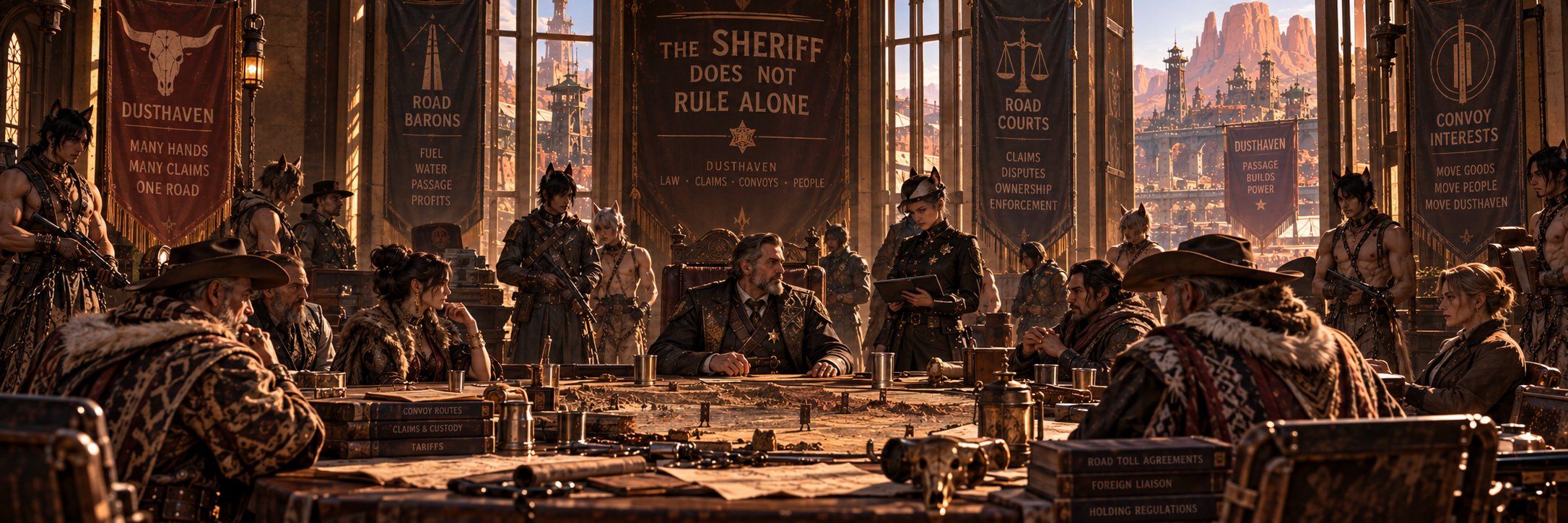
Mesquite Reach leaders meeting while chained demi-human guards stand under human authority
Government · Practical Authority

Whoever Holds the Road

Mesquite Reach has a national government. It simply does not have the luxury of pretending national authority is the only authority that matters.

The Reach Assembly, Dust Governor, Road Courts and Sheriff-Marshals provide the formal structure. Road Barons, convoy companies, water holders, old ranch families and armed local interests determine how much of that structure survives once a ruling leaves the room.

Power in Mesquite is measured less by title than by passage. Whoever controls the road, water, fuel, armed force or paperwork can become the law long enough to matter.

Formal Institutions

The Government on Paper

Reach Assembly

A national council of district representatives, town bosses, road authorities, land interests, guilds and corporate-backed delegates. It can make law. Enforcement remains a separate argument.

Dust Governor

Nominal head of state with authority over diplomacy, emergencies and high-level trade. Actual influence rises and falls with Road Baron support, militia cooperation and outside money.

Road Courts

Traveling and semi-mobile courts handling contracts, debts, bounty claims, ownership disputes, convoy crime and border incidents.

Sheriff-Marshals

Local authorities with enormous autonomy. Some keep towns functioning. Others merely give private violence a badge and a filing system.

Ashland Compact

A loose agreement between major towns, convoy interests and militias built around one practical fear: if the roads collapse completely, the country starves.

Actual Power Structure

The Government on the Road

Formal office matters. So does possession of the things that let everyone else keep moving.

Roads
Water
Fuel
Guns
Paper
Local Loyalty

The Reach Assembly writes laws. Passage decides whether anyone cares.

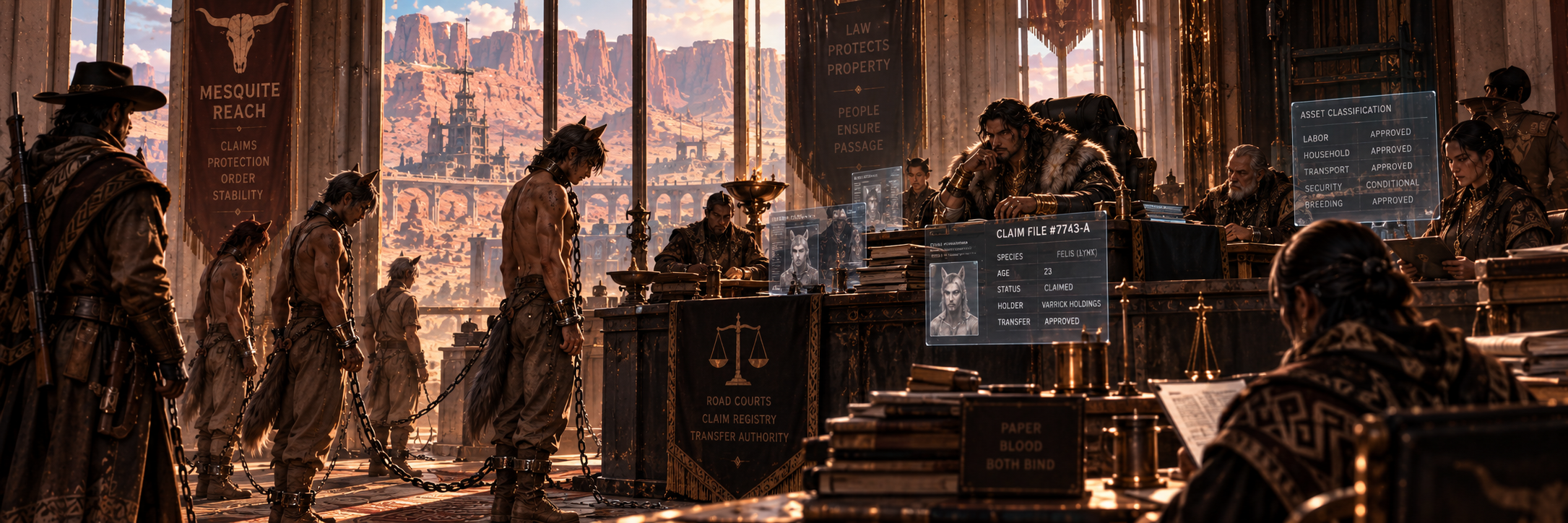
Mesquite Road Court reviewing ownership claims while chained demi-humans wait before officials
Law · Claim · Custody

Every Claim Has a Price

Mesquite law is dangerous because it is usable. Ownership, debt, bounty, salvage and local authority overlap until the person with the strongest recognized claim can turn violence into procedure.

The Reach does not need one perfectly centralized slave code. It needs courts willing to recognize claims, officials willing to accept documents, armed people willing to enforce them and a society that does not regard demi-humans as people whose consent matters.

Legal Principles

The Laws That Make People Property

Claim Principle

A claim survives when someone can produce it, defend it and convince the local authority to recognize it.

Road Right

Paid protection is supposed to guarantee passage through participating territory. Supposed to.

Dust Debt

Water, food, shelter, medicine, transport and protection can be converted into labor obligation.

Salvage Law

Abandoned property may be claimed. Corrupt actors stretch the definition of abandoned until it includes bodies.

Bounty Recognition

Foreign ownership and recovery claims may be honored once papers and fees satisfy local authority.

Local Exception Rule

Towns can impose emergency restrictions, seizures, curfews and shift controls when local leaders declare necessity.

Human Priority Clause

Human testimony and human claim documents receive priority when disputes involve enslaved demi-humans.

Ownership Processing

When a Person Becomes Paper

Mesquite ownership does not require philosophical consistency. It requires a chain of recognition strong enough to survive the next checkpoint.

Captured
›
Claimed
›
Registered
›
Transferred
›
Sold

Forgery changes the paper. Escape changes the location. Neither makes the ownership system stop looking.

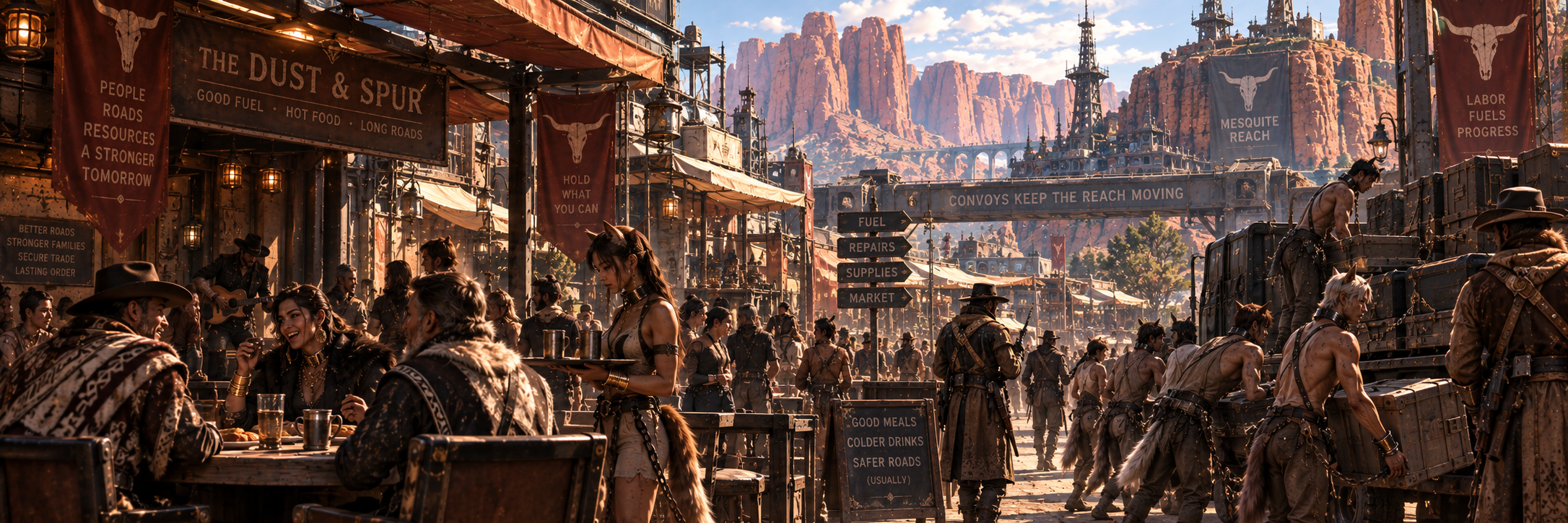
Mesquite market where human families and workers live ordinary lives beside chained demi-human laborers
Human Society

The People Who Think They Are Free

Human life in the Reach can be poor, dangerous and deeply constrained by debt. Water costs money. Roads cost money. Fuel, medicine and protection cost money. Courts can be corrupt and work can disappear with one closed route.

None of that makes the human population property. That distinction matters. Even a poor human in Mesquite participates in a legal order that recognizes them as human while denying the same status to the chained demi-human working beside them.

Human Social Structure

Who Lives Above Whom

Road Barons

Control highways, toll houses, fuel, convoy permissions and water depots. Their wealth is measured in passage.

Old Ranch Houses

Hold vast scrubland territories, private wells, armed retainers and long-standing systems of demi-human bondage.

Convoy Class

Drivers, guards, mechanics, haulers and brokers who keep the Reach supplied and move much of what makes it monstrous.

Sheriffs & Bounty Interests

The boundary between local enforcement and paid recovery work is often more theoretical than residents would like.

Dust Poor

Human families trapped by unreliable work, fuel costs, water debt, road tolls and failing settlements.

Class and Personhood

Human Poverty Is Not Human Bondage

Human Debt

Crushing, Corrupt, Sometimes Generational

A human may lose housing, water access, employment, transport or local protection. Their situation can be brutal. The law still recognizes that a human exists as a person beneath the debt.

Demi-Human Ownership

Personhood Denied at the Starting Line

A demi-human is not merely indebted. They are treated as claimable property whose movement, labor, sale and restraint are controlled by humans.

The ruling order fears human and demi-human solidarity precisely because the two systems are not identical, but they are maintained by many of the same hands.

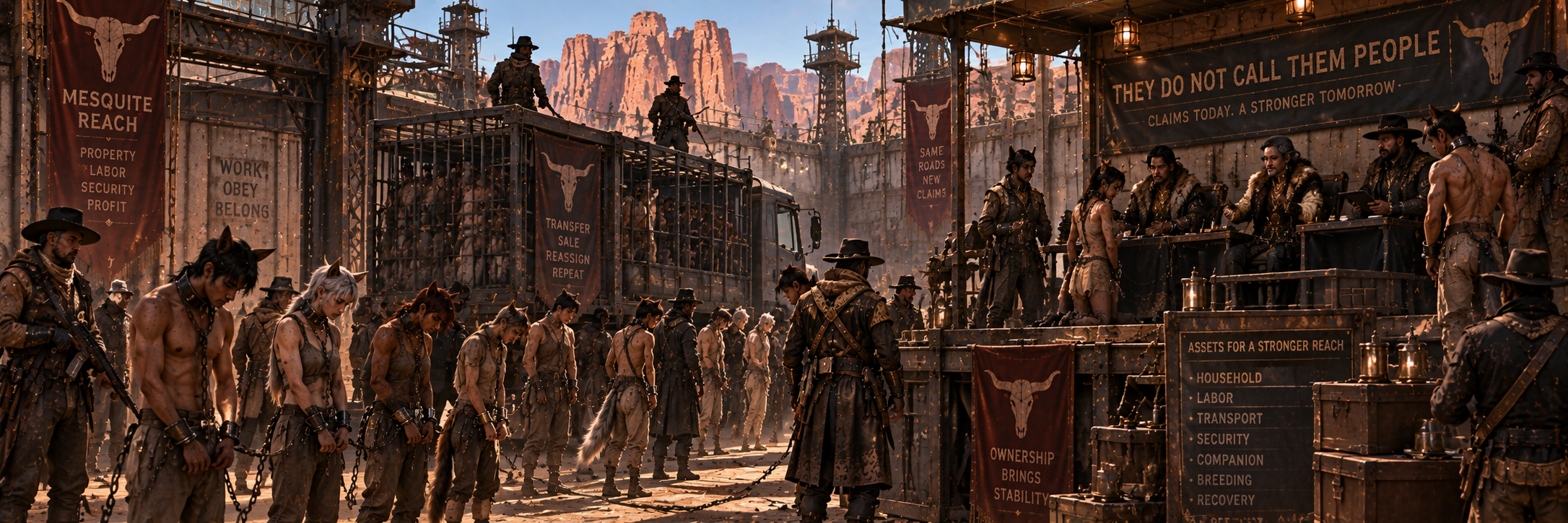
Chained demi-human slaves processed at a Mesquite Reach transfer compound
Demi-Human Status

They Do Not Call Them People

In Mesquite Reach, demi-humans are not treated as a subordinate citizen class. They are not viewed as human at all. They are chained, assigned, transported, sold, inherited, reclaimed and worked as property.

Their animal traits affect what humans believe they are useful for. Strength becomes hauling. Scent becomes tracking. Speed becomes courier work. Predatory morphology becomes security labor. Even a demi-human trusted with a weapon remains a slave.

Ownership Manifest

Owned by Default

Household

Domestic service, personal attendance, cleaning, carrying, household labor and private status display.

Ranch

Field work, animal handling, water hauling, perimeter work, repair assistance and isolated family ownership.

Road Labor

Loading, unloading, repairs, fuel work, roadside service and convoy infrastructure.

Transport

Captives moved between towns, buyers, auction points, ranch houses, foreign interests and other claims.

Security

Tracking, guarding, scouting and combat performed under human command and physical restraint.

Recovery

Captured fugitives returned to owners, bounty claimants or new buyers through the same road network used for ordinary trade.

Security Classification

A Weapon Is Not Freedom

Mesquite slavers sometimes use demi-humans as trackers, scouts, fighters and guards. The job does not change their status.

Combat AuthorizationYes
Weapon AccessConditional
Handler AuthorityHuman
Wrist RestraintRequired
Ankle RestraintMovement Slack
PersonhoodNot Recognized

A demi-human may be trusted to fight and still not be trusted with their own hands.

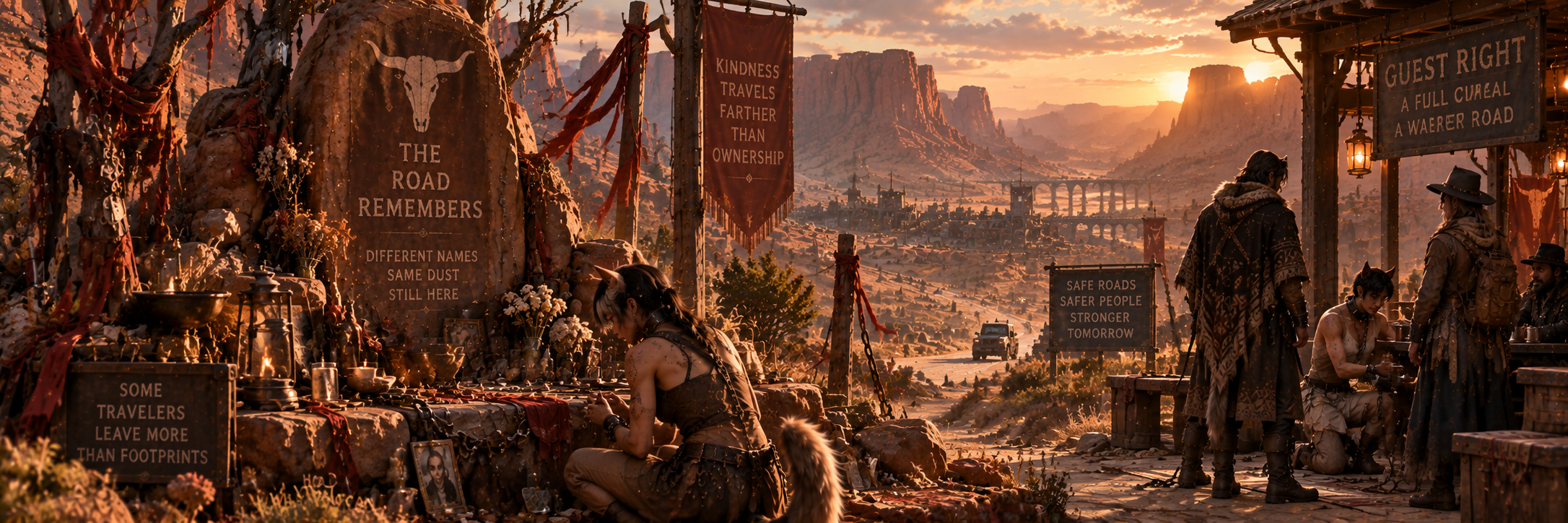
Mesquite roadside memorial with red thread, offerings, travelers and a chained demi-human servant
Culture · Memory · Road Custom

The Road Remembers

Mesquite culture grew around movement, scarcity, death and the knowledge that official records are often less reliable than what travelers remember.

Its customs can be compassionate without being egalitarian. A human household may consider Guest Right sacred while keeping demi-humans chained. A community may mourn the dead without questioning who was allowed to own the living. Contradiction is not an exception here. It is culture.

Road Customs

Rules Nobody Wrote Down

Guest Right

In some homes and road stops, food and water given beneath a roof protect a traveler until sunrise. False sanctuaries imitate the custom because people trust old rules.

Water Debt

Giving water may create gratitude, obligation or leverage. Mercy and control use the same cup.

Road Names

Travelers often use names unrelated to their legal identities. The practice protects fugitives, criminals, hidden hybrids and anyone whose real name belongs to dangerous paperwork.

No Questions at Supper

Some households refuse names until morning. It can shelter the hunted. It can also shelter the hunter.

Red Doors

A red door may mean sanctuary, danger, an old memory or someone copying a symbol they do not deserve.

The Third Chair

An empty chair at a table means someone is missing from the road.

Memory Practices

What Survivors Leave Behind

Dust Saints

Roadside memorial figures built around dead travelers, lost children, betrayed guides, rebels and unidentified bodies.

Road Vigils

Pre-crossing rituals using ash, oil, dust, small offerings and whatever superstition a crew trusts more than the weather report.

Red Thread

Tied to a wrist, tail, horn, old collar scar or vehicle mirror. It can mean survival, loss, rescue debt, pursuit or remembrance.

Ash Baptism

Some Dust-Free communities mark the end of an old recorded identity with ash and water before a new life begins under another name.

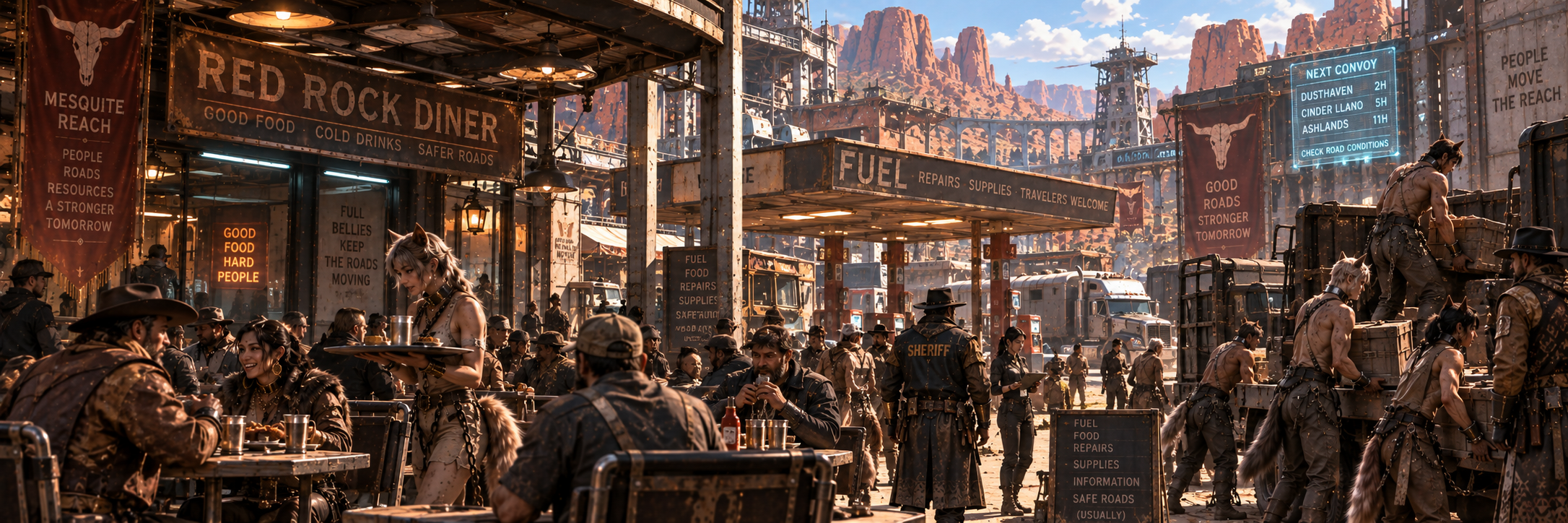
Everyday Mesquite roadside life with diners, fuel stops, convoys and visibly chained demi-human workers
Daily Life

Ordinary Life Under Chains

Mesquite does not stop for its own brutality. People still eat breakfast, complain about fuel prices, repair trucks, send children to school, buy medicine, flirt at counters and wait for convoys to arrive.

Enslaved demi-humans exist inside those routines. A chained server carrying coffee is not treated as an emergency. A restrained mechanic assisting in a repair bay is not treated as remarkable. Oppression survives because ordinary life has learned how to make room for it without interrupting lunch.

Ordinary Schedule

A Tuesday in Mesquite

06:10

Fuel boards update before the morning convoys leave.

07:30

Water lines form. Parents check storm warnings before sending children toward school or work.

10:20

Repair yards are already hot. Road crews trade parts, gossip and route information.

12:40

Diners fill with drivers, bounty crews, clerks, mechanics and people killing time before the next road opens.

15:15

Convoy arrivals bring freight, strangers, rumors and occasionally somebody another town is looking for.

18:30

Heat drops. Markets become social spaces. Repair bays stay open.

21:00

Road conditions are checked again. Anyone traveling under another name decides whether tonight is worth the risk.

Technology · Infrastructure

What People Actually Use

Wrist-Comms

Cracked, rebuilt and modified for burner identities, false records, maps, payment and communication.

Holo Signs

Fuel prices, missing-person notices, bounty listings, road closures, advertising and route warnings share the same battered displays.

Portable Scanners

Used by courts, markets, bounty crews, slavers, clinics and anyone rich enough to buy certainty.

Convoy Jammers

Tracking disruption can indicate trafficking, rescue, smuggling or ordinary criminal caution.

Water Gates

Access tied to accounts, claims, town permissions and whatever authority controls the local supply.

Old Rail AI

Fragments of abandoned transport systems still open doors, issue obsolete announcements and occasionally create useful errors.

Patched Solar

Mismatched panels and battery banks keep isolated infrastructure alive long after original owners disappear.

Mesquite resistance contacts preparing to move fugitives as a dust storm approaches a roadside stop
Resistance · Rescue · Retaliation

No Route Is Safe Twice

Mesquite resistance does not look like one rebellion. It looks like kitchens, laundries, broken bounty boards, hidden camps, altered road signs, forged papers, sabotaged trackers and people who disagree violently about what justice should look like.

The networks survive by assuming betrayal is possible. Routes change. Marks change. Guides disappear. Safehouses become unsafe. Rescue information ages faster than maps.

Resistance Networks

The People Who Move People

The Red Thread

Decentralized rescue network using memory, knots, altered signs, fabric marks, coded orders and constantly changing routes.

The Ash Mothers

Mostly women and elders hiding children, injured fugitives, exposed hybrids and people too exhausted to keep moving.

Jacklight Crews

Saboteurs who attack bounty boards, trackers, scan towers and corrupt toll infrastructure.

Dust-Free Communities

Hidden settlements of escaped demi-humans, hybrids, outlaw humans, defectors and people erased from clean identity systems.

Mercy Knives

Vigilantes targeting traffickers, false sanctuary operators and repeat bounty crews. Other resistance groups distrust how easily punishment can become vengeance.

Route Advisory

A Safehouse Until It Isn't

Mesquite has no permanent visual language of safety. Red doors get copied. Route marks are discovered. Guides are bought. A clinic changes hands. A family becomes frightened. A bounty becomes valuable enough to change somebody's conscience.

Safe Yesterday Route information already aging.
Unknown Today Ownership or personnel may have changed.
Do Not Reuse A successful route becomes visible through success.
Claim Activity Detected Foreign bounty or local recovery interest nearby.
Guide Unconfirmed Identity, allegiance or survival status unknown.
Symbol Compromised Do not assume a familiar mark means familiar hands.

Mesquite Reach does not promise freedom. It only contains roads where freedom might still be reached.

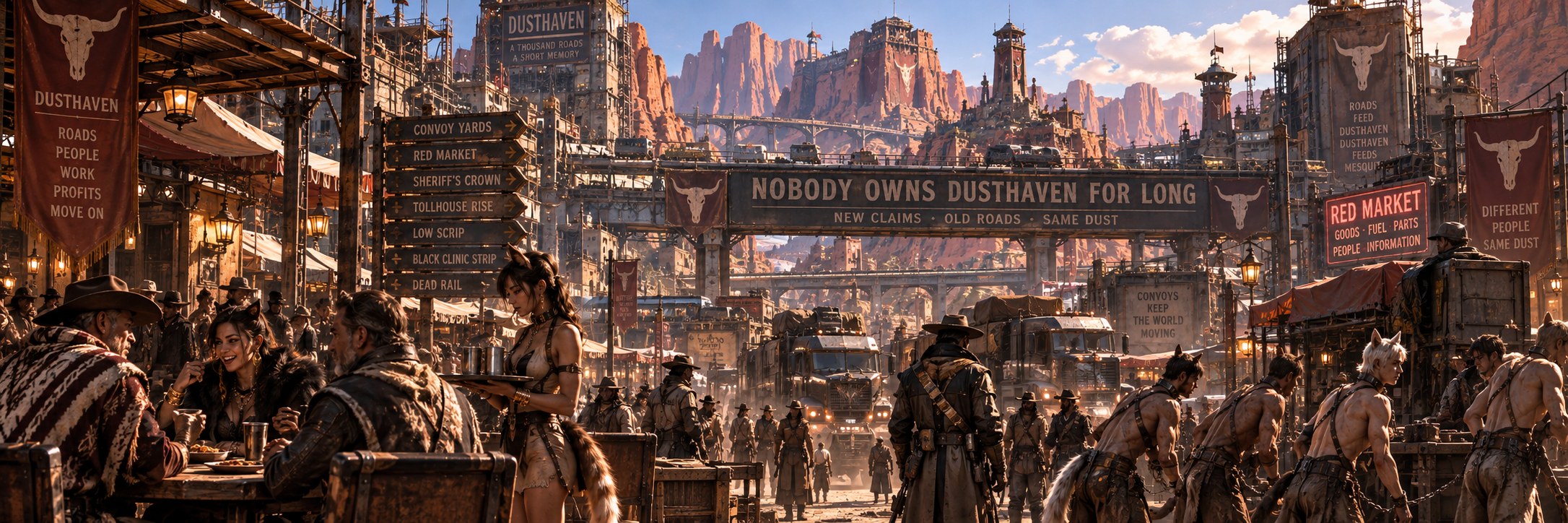
Dusthaven road-city beneath red sandstone cliffs with convoys, markets and chained demi-human workers
Dusthaven · City Overview

Nobody Owns Dusthaven for Long

Dusthaven is the largest city in Mesquite Reach and the closest thing the country has to a capital people consistently take seriously. The Old Red Road runs straight through it, carrying convoys, fugitives, bounty crews, forged papers, foreign agents, medicine, stolen records and people traveling under names that do not belong to any government file.

It survives by never belonging completely to one authority. Sheriffs enforce claims, Road Barons control passage, convoy interests move freight, foreign governments buy influence and underground networks exploit every crack between them.

Dusthaven is not safe, clean or honest. It is alive, and that has proven harder to control.

City Identity

The City of Second Names

OfficialThe Road Capital
OfficialThe Haven of the Llano
StreetClaimtown
StreetBounty Bell
StreetThe City of Second Names
Road NameThe Last Stop Before Nobody Knows

A person can arrive with papers, a road name or nothing at all. Dusthaven mostly cares whether somebody else is already looking for them.

Movement Manifest

Everything Passes Through Here

Convoy TrafficFreight crews, road guards, mechanics, haulers, medical transports and vehicles whose manifests become less convincing after sunset.
Claim TrafficBounty hunters, slavers, foreign recovery teams and owners following people who would rather stay missing.
Paper TrafficForged identities, altered ownership records, stolen Purity Grid data and documents meant to survive one checkpoint.
Foreign TrafficPecos recovery teams, Brazorian investigators, San Aurelean intermediaries, Thornwyck operatives and Veyrhalden smugglers.
Ghost TrafficFugitives, hidden hybrids, sanctuary workers and people officially dead enough to become useful.
Elevated view of Dusthaven and the Old Red Spine passing through its major districts
Districts · Movement · Geography

The City Built Around the Road

Dusthaven did not grow outward from a palace, harbor or planned civic center. It grew around movement. The Old Red Spine cuts through the city, and nearly every district defines itself by what it needs from the road or what it can extract from the people using it.

Convoy yards spread around freight access. Markets gather around arrivals. Poor housing occupies whatever infrastructure wealth no longer wants. Government sits high enough to look authoritative. The Dead Rail survives beneath all of it, quietly refusing to become irrelevant.

District Directory · Central Dusthaven

Which Side of the Spine?

Old Red Spine

The central highway district. Fortified diners, repair garages, fuel stops, road shrines, cheap motels, toll offices and bounty boards line the route.

Sheriff's Crown

The fortified civic district housing the Sheriff-Marshal, Road Courts, records, claim registries, holding cells and emergency watchtowers.

Convoy Yards

A sprawling freight zone of trucks, armored buses, cattle haulers, repair bays, salvage rigs, transport companies and mercenary traffic.

Red Market

Dusthaven's main commercial district. Food, parts and medicine move openly. False papers, scan spoofs, stolen data and ownership business require knowing where to ask.

District Directory · Outer Layers

Where the City Gets Personal

Low Scrip

Debt workers, road widows, poor families, old mechanics, hidden hybrids and residents living through town scrip crowd patched apartments and converted motels.

Black Clinic Strip

Unofficial medical rooms behind laundries, pawn shops and mechanic bays. Some remove restraints and save fugitives. Others verify bounties.

Tollhouse Rise

Road Baron wealth, convoy ownership, fuel families and water brokers. Its residents do not formally rule Dusthaven, which is an adorable technicality.

Saint Ash Quarter

Shrines, storm shelters, red-thread memorials, cheap kitchens and some of the city's strongest Ash Mother contacts.

Dead Rail

Collapsed platforms, sealed freight tunnels, ghost tracks and obsolete rail systems used by smugglers, Jacklight Crews and underground routes.

Dusthaven political leaders, Road Barons and officials negotiating inside Sheriff's Crown
Government · Local Authority

The Sheriff Does Not Rule Alone

The Sheriff-Marshal may be Dusthaven's most visible authority, but visibility is not the same thing as control. Road Courts determine claims. Road Barons influence fuel and passage. Convoy owners control essential movement. Foreign governments arrive carrying money, warrants and expectations.

A strong Sheriff-Marshal can keep those interests negotiating instead of shooting. A weak one simply becomes another name somebody else uses to justify what they already intended to do.

Civic Government

Who Signs the Claim?

Sheriff-Marshal

Accepts, rejects, delays and enforces local warrants and bounty claims while trying to keep every armed interest from deciding it can do better.

Road Court Hall

Handles ownership disputes, convoy crime, Dust Debt, salvage claims, bounty challenges and border incidents.

Claim Registry

Records who supposedly owns what. In Dusthaven, paperwork can be legitimate, forged, purchased, outdated or all four before lunch.

Holding Authority

Maintains temporary detention and disputed-custody facilities while courts decide which claim receives recognition.

Dust Governor

Represents national authority when present in the city, though the office depends heavily on whoever currently controls roads, fuel and armed cooperation.

Influence Ledger

Who Actually Gets Their Way?

Road BaronsFuel, tolls, water access and convoy passage.High
Sheriff's CrownLaw, warrants, claims and visible enforcement.Local
Convoy HousesFreight movement, transport labor and road intelligence.High
Bounty InterestsRecovery contracts, foreign claims and private enforcement money.Bought
Foreign StatesPecos, San Aurelo and Brazoria apply money, diplomacy and threats.Pressure
UndergroundSabotage, sanctuary, leaks and the ability to make official certainty fail.Disputed

Dusthaven has one municipal government and several competing definitions of authority.

Human residents of Dusthaven living and working along the Old Red Spine beside enslaved demi-humans
Human Society

Everyone Has Something to Lose

Dusthaven's human population ranges from Road Baron families with control over entire transport corridors to mechanics trying to keep one truck running until payday. Between them are convoy workers, merchants, deputies, bounty hunters, smugglers, clerks, doctors, students and families who would prefer politics to remain somebody else's emergency.

The city's inequality is severe, but every human class still occupies legal personhood above the demi-humans chained into its labor system.

City Population

The People Above the Claim Line

Road Baron Agents

Manage tolls, contracts, fuel interests and whatever politely worded threat is required to protect passage.

Convoy Families

Drivers, mechanics, guards, dispatchers and freight workers whose lives follow route schedules more closely than calendars.

Market Merchants

Food sellers, parts dealers, medicine brokers, tailors, repair vendors and people with a second inventory they do not show strangers.

Deputies

Enforce Sheriff's Crown authority while navigating gangs, Road Barons, bounty houses and citizens who know exactly how negotiable enforcement can be.

Bounty Crews

Professional hunters, desperate locals and private contractors pursuing claims issued inside and outside Mesquite Reach.

Ordinary Families

People paying rent, buying food, raising children and arranging their lives around the next fuel spike or road closure.

Human Poverty · Low Scrip

Low Scrip Doesn't Feel Free Either

For poor humans, Dusthaven can turn freedom into a very technical definition. A person can legally leave while lacking the fuel, water, wages or transport required to do it.

HousingUnstable
FuelRising
WaterDebt Risk
MedicineExpensive
Convoy WorkIrregular
Road TollsVariable

Human poverty can trap someone inside Dusthaven. Demi-human slavery begins from the assumption that leaving was never theirs to decide.

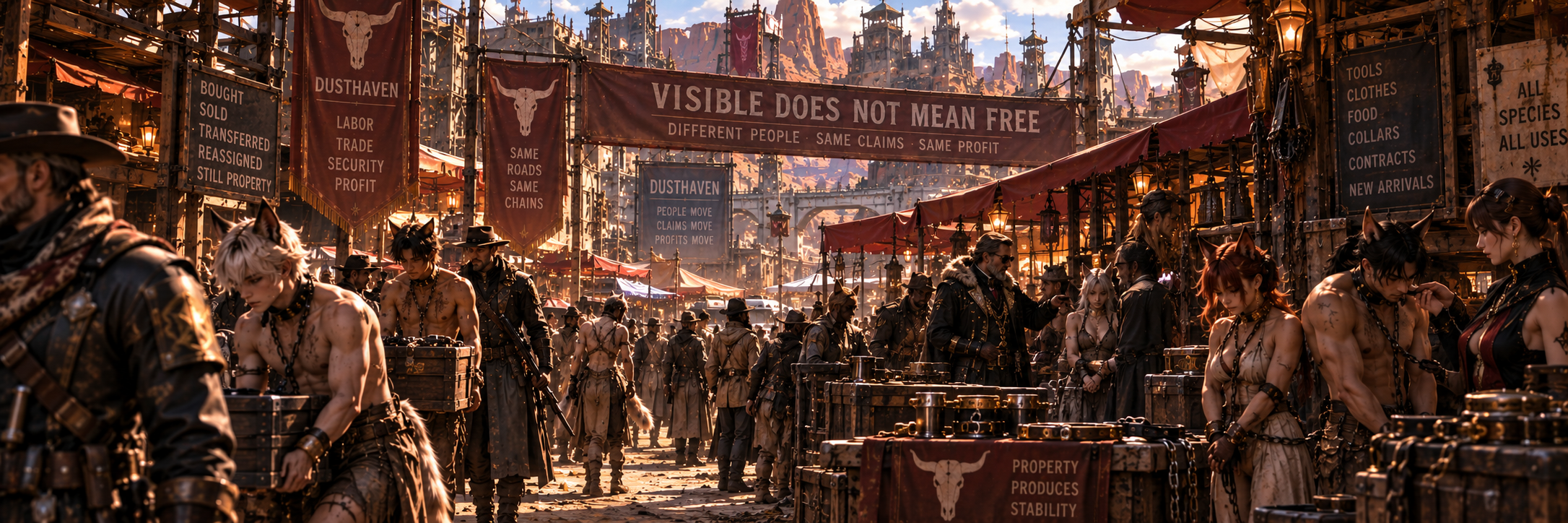
Enslaved demi-humans visibly chained while working throughout Dusthaven's market streets
Demi-Humans · Slavery · Labor

Visible Does Not Mean Free

Dusthaven does not hide demi-human slavery. Chained demi-humans serve meals, unload convoys, carry freight, assist mechanics, track fugitives, guard property and move through markets in full public view.

The city does not interpret visibility as citizenship. A demi-human can spend their entire life in Dusthaven's streets while humans still understand the chain before they understand the name.

City Labor Assignment

What Dusthaven Uses Them For

Domestic Service

Household cleaning, carrying, attendance, errands and private labor.

Diner Service

Cooking, food preparation, table service, cleaning and supply handling.

Freight Labor

Loading, unloading, moving crates and handling convoy cargo.

Repair Assistance

Tool handling, mechanical support, hauling parts and working beneath vehicle bays.

Tracking

Canine and other scent-capable demi-humans used by bounty interests and recovery crews.

Guard Work

Armed security performed under human authority while the demi-human guard remains physically restrained.

Road Scouting

Species traits exploited for visibility, scent, speed, navigation or harsh-environment travel.

Market Handling

Service, transport, display and the administrative movement of enslaved people between claims.

Claim Status

A Claim Can Change Before Sunset

The identity imposed on an enslaved demi-human can change as quickly as Dusthaven's paperwork.

Registered
›
Disputed
›
Seized
›
Transferred
›
Sold

The claimant can change. Dusthaven's assumption that somebody should hold the claim usually does not.

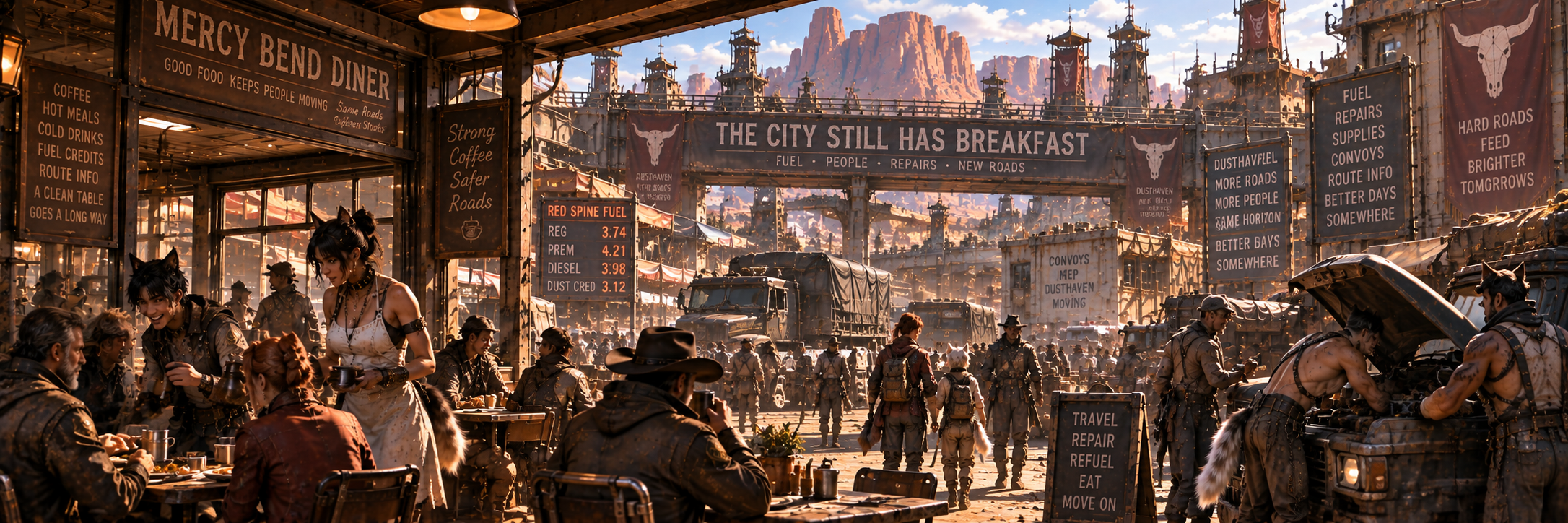
Morning in Dusthaven with diners, convoy traffic, repair work and chained demi-human workers
Daily Life

The City Still Has Breakfast

Dusthaven wakes early because roads do. Coffee starts before court. Repair bays open before the heat settles in. Convoy crews eat beside strangers they may never see again, children leave for school and fuel boards update while half the city complains about yesterday's prices.

Slavery does not interrupt any of this. It is embedded inside it, visible in the chained server refilling a cup and the restrained mechanic passing tools beneath an open hood.

Daily Rhythm

From First Coffee to Last Convoy

05:30

Night convoys arrive while breakfast counters begin serving drivers and rail-side workers.

07:00

Fuel queues build along the Spine and repair yards start taking the day's first jobs.

09:00

Road Courts and claim offices open. Somebody is already waiting outside.

11:30

Red Market hits its busiest daylight trade period.

14:00

Repair bays, freight yards and water depots choke with mid-route traffic.

17:00

Eastbound and Ashland convoys begin assembling before evening travel.

20:00

Red Market becomes less official and Black Clinic Strip becomes busier.

00:00

Dead Rail traffic increases while the main roads grow quieter.

Local Bulletin

What People Worry About Today

Water PriceDid Chainwater raise rates again?
Fuel AccessWhich Road Baron is threatening supply this week?
Road StatusOpen, delayed, under claim or currently being shot at?
Dust WarningEnough to delay traffic, or enough to make people disappear?
MedicineCan the clinic treat it, can the family afford it, and who will the clinic tell?
Missing ConvoyLate, rerouted, stolen, captured or something nobody wants to put on a board?
SchoolWhich route is safe enough for children this morning?
CheckpointWhich sheriff, bounty house or foreign recovery team is checking papers today?
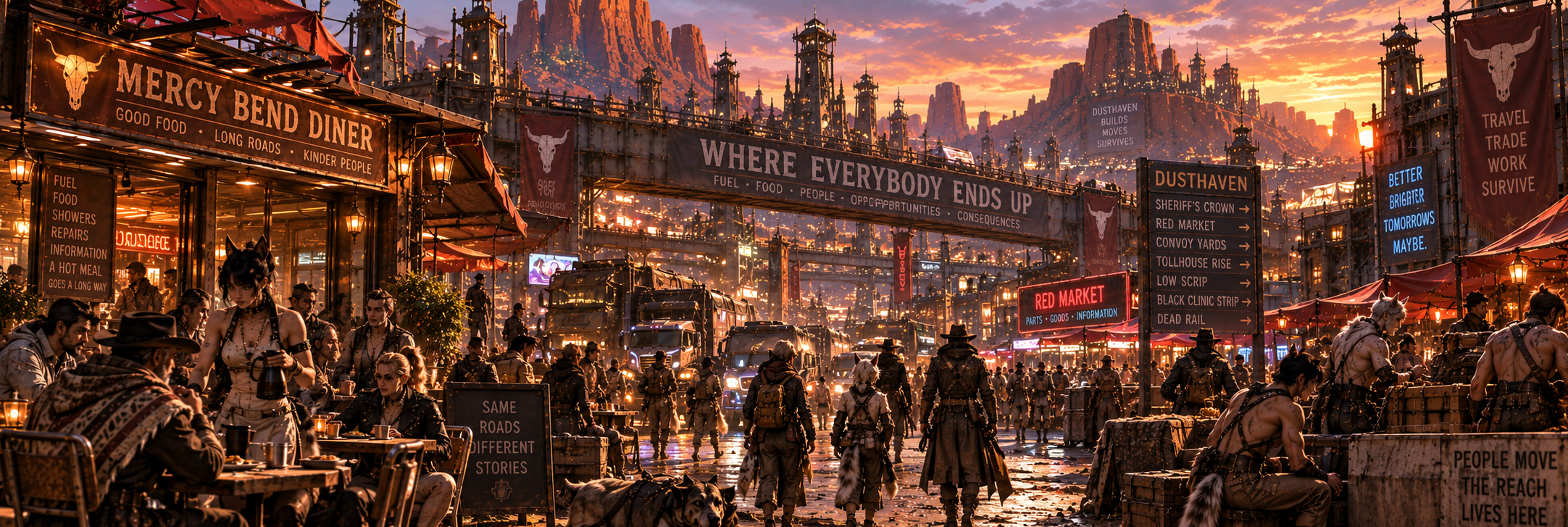
Dusthaven Old Red Spine at evening with Mercy Bend Diner, Red Market and heavy road traffic
Places · Landmarks · Social Life

Where Everybody Ends Up

Dusthaven's important places are rarely isolated monuments. They sit beside diners, repair bays, market stalls, fuel depots and cheap rooms because this is a city organized around movement rather than ceremony.

The same road can take someone to court, breakfast, a bounty board, an emergency clinic, a smuggler or a gate out of town. Sometimes the useful part is knowing which door comes before the next one.

Civic & Infrastructure Directory

Places That Move the City

Sheriff's Crown · Government

Sheriff-Marshal's House

Part courthouse, jail, war room and political stage. Bounty claims can be accepted, rejected, delayed or quietly sold here.

Sheriff's Crown · Court

Road Court Hall

Ownership disputes, Dust Debt, bounty challenges, salvage cases and convoy crimes become official enough to hurt people.

Old Red Spine · Holo Board

Red Spine Bounty Board

Wanted fugitives, escaped slaves, missing trucks, debt runners and road warnings update across one massive flickering display.

Road Infrastructure · Water & Fuel

Chainwater Depot

A major staging compound whose water and fuel access can determine who crosses the Ashlands and who waits.

Civic District · National Government

Dust Governor's Residence

A guarded political residence now carrying considerably more paranoia after the assassination attempt.

Eastern Exit · Road Control

Tollhouse Seven

Permits, cargo clearances, tolls and road closures. False papers may work if the clerk is bought, scared or sympathetic.

Sheriff's Crown · Records

The Unclaimed Office

Handles salvage, unidentified dead, disputed cargo and unpapered travelers. Bureaucracy here can turn a body into claimable matter.

Southern Gate · Ashlands

Coyote Gate

Convoys leave Dusthaven toward the Llano Ashlands under escort, debt, desperation or hope.

Daily Life Directory

Places People Actually Go

Old Red Spine · Fortified Diner

Mercy Bend Diner

Bad coffee, good information and a crowd made of convoy crews, deputies, smugglers, bounty hunters and desperate travelers.

Saint Ash Quarter · Food Hall

Saint Ash Kitchen

A public kitchen run by widows, old road workers, hidden hybrids and Ash Mother sympathizers. Eat first. Lie after.

Low Scrip · Laundry

Red Thread Laundry

A completely functional laundry where stitch colors, folded sheets and repaired cuffs may also carry route information.

Old Red Spine · Repair

Brindle's Scan & Salvage

Repairs wrist-comms, drones, scanners, convoy jammers and old rail tech. ID work depends heavily on trust.

Old Red Road · Motel

Quiet Turn Motel

Cheap rooms, false names, back exits and a front desk with entirely too much knowledge about who arrived with whom.

Central Trade · Market

Red Market

Food, clothing, tools, medicine, parts and road supplies by day. Much less wholesome inventories after dark.

Black Clinic Strip · Medicine

Black Clinic of Dr. Valez

A former Brazorian doctor's backroom clinic treating restraint injuries, hidden hybrid complications, convoy wounds and dangerous paperwork problems.

Low Scrip · Neighborhood

Low Scrip Streets

Converted motels, food counters, cheap shops, repair stalls and dense residential blocks where residents know one another by routine and debt.

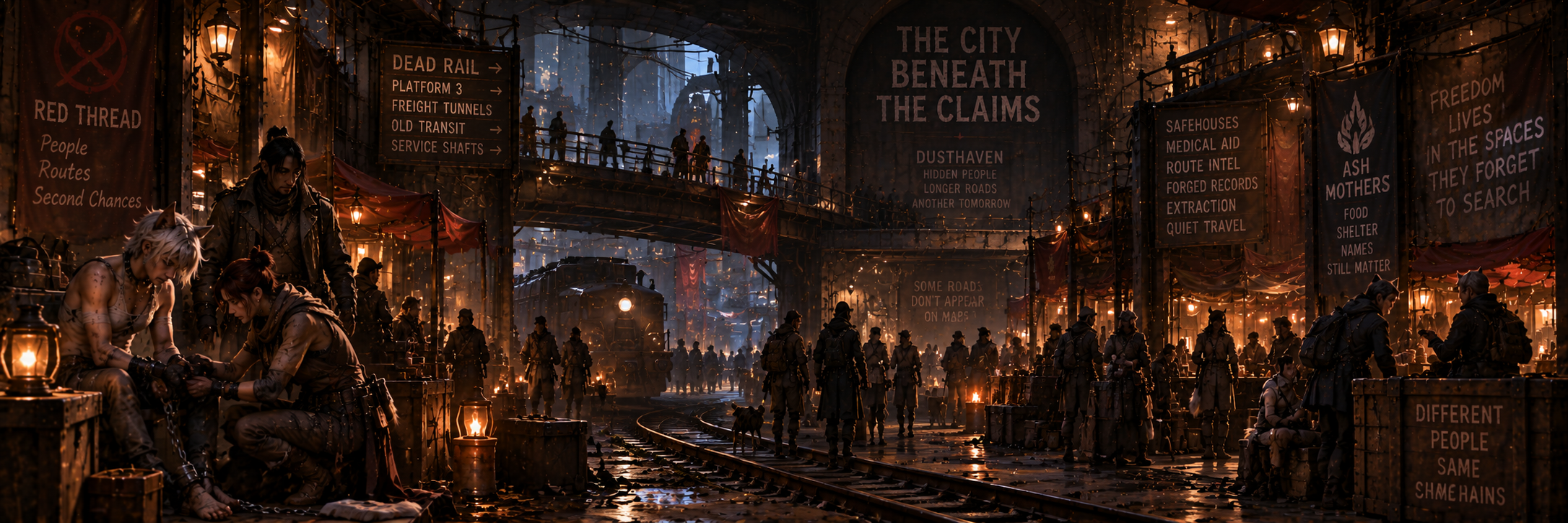
Dusthaven underground routes beneath Dead Rail with fugitives, smugglers and resistance contacts
Underground · Dead Rail · Sanctuary

The City Beneath the Claims

Below Dusthaven's roads is another movement system built from abandoned rail tunnels, service shafts, clinic rooms, laundries, kitchens, hidden freight spaces and whatever buildings happen to have doors nobody checks anymore.

The underground is not one organization. Red Thread contacts, Ash Mothers, smugglers, hidden hybrids, Jacklight Crews, Veyrhalden runners and Thornwyck operatives may use the same infrastructure without trusting one another.

Underground Networks

Who Works Below the Road

Red ThreadMoves fugitives, changes routes and tracks false sanctuary activity.Paranoid
Ash MothersShelter children, injured fugitives, exposed hybrids and people unable to keep moving.Quiet
Jacklight CrewsAttack bounty boards, trackers, towers and the infrastructure used to maintain certainty.Reckless
Black ClinicsMedicine, restraint removal, document alteration and occasional betrayal depending on who operates the room.Mixed
Veyrhalden RunnersBuy passage and move fugitives toward southeastern routes and eventual coastal contacts.Costly
Thornwyck ContactsTry to establish defensible chains of sanctuary inside a city that regards reliable chains as a challenge.Watched
Mercy KnivesHunt repeat traffickers and false sanctuary operators while making several allies uncomfortable with what comes afterward.Feared
Live Sanctuary Status

Safe Until Somebody Sells the Address

Dusthaven has plenty of hiding places. Reliability is the scarce resource.

Red Door ChapelUnverified
Third Chair RoomLimited Access
Dead Rail Platform 3Active / Watched
Quiet Turn MotelMixed Traffic
Black Clinic ContactsVerify First
Eastern Sanctuary RouteCompromised
Copied Red DoorsDo Not Trust

Dusthaven has more places to hide than most cities in Vistall. It also has more people being paid to find them.

Cinder Llano salvage town beneath red sandstone with burned infrastructure and chained demi-human workers
Cinder Llano · City Overview

If the Paper Survived the Fire

Cinder Llano is a hard Ashland town built around salvage, convoy repair, illegal medicine and records that become remarkably flexible once somebody important needs them to be. Smaller than Dusthaven and quieter about its violence, it survives by knowing what can be burned, what can be rewritten and what somebody will pay to recover.

Old Brazorian facilities, dead rail infrastructure and failed corporate sites give the town a steady supply of machinery, abandoned data and secrets that technically belong to someone else.

If the paper survived the fire, someone meant it to.

City Identity

The Town That Pretends Not to Remember

OfficialAshland Crossing
OfficialSouth Llano Hub
OfficialThe Salvage Gate
StreetAshclaim
StreetBurnt Paper Town
StreetThe Place Files Go to Die
StreetBlackgrass
StreetCinder Lie
Foreign Entanglement

Dirty Work Needs an Address

Brazoria ValeWants old Purity Grid records, conservatory transfers and abandoned biological data back before somebody else decides what they are worth.
San AureloLooks for erased ownership files, missing domestic assets and records that could connect polished institutions to uglier transfers.
Pecos CrownUses local guides and bounty routes while openly despising the town's unreliability.
ThornwyckSeeks testimony, former captives and safe movement through a place where evidence is constantly at risk.
VeyrhaldenBuys passage through eastern routes when Blackfen-linked smugglers need the Ashlands behind them quickly.

Cinder Llano is where other countries send problems they would prefer to become difficult to prove.

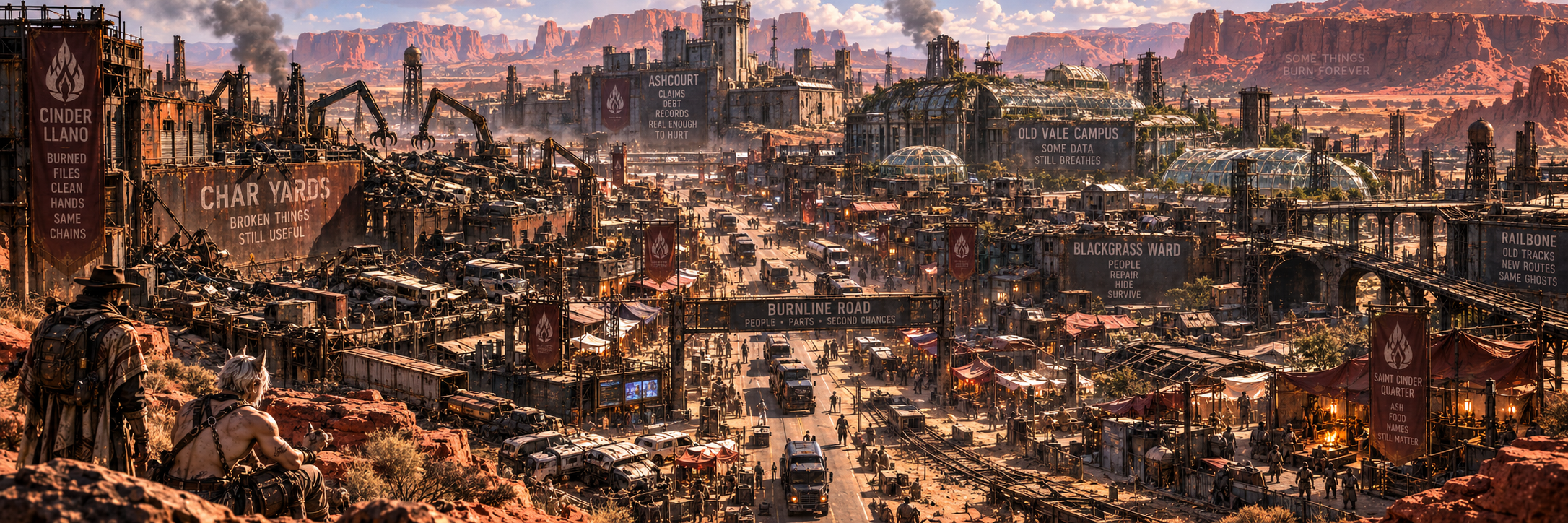
Panoramic view of Cinder Llano built over salvage yards, burned districts, dead rail and old Brazorian facilities
Districts · Salvage · Ash

Built Over What Already Burned

Cinder Llano grew by occupying what other governments and corporations abandoned. Burned campuses became markets. Dead rail became passage. Industrial yards became neighborhoods. Old greenhouses became clinics, shelters or places people insist are empty.

The result is a town where every district contains at least one previous version of itself underneath the current one.

District Directory · Official Cinder

Where the Records Still Work

Burnline Road

The main road through town. Convoys, fuel sellers, fortified diners, shrines and storm shelters line the route.

Char Yards

Burned vehicles, dead scanners, old collars, broken drones, medical equipment and rail parts are repaired, dismantled or sold.

Ashcourt

Sheriff office, claim registry, Road Court annex, debt clerks, holding rooms and emergency shelters.

Old Vale Campus

An abandoned Brazorian research-agriculture complex whose dead servers remain inconveniently interesting.

District Directory · Unofficial Cinder

Where the Records Stop Working

Blackgrass Ward

Poor residents, road families, hidden hybrids, debt workers and people living under identities nobody checks too closely.

Railbone

Dead platforms, broken tracks, old AI boxes and freight routes no current map likes admitting still function.

Saint Cinder Quarter

Shrines, kitchens, old churches, ash rituals, traveler shelters and the strongest local traditions of Guest Right.

Cinder's official districts are where the town keeps records. The useful districts are where the records stop asking questions.

Cinder Llano claim hearing with officials reviewing disputed records while a chained demi-human stands before them
Ashcourt · Claims · Records

A Warrant Is an Opening Bid

Cinder Llano has law, but law here behaves more like negotiation than certainty. A warrant can be challenged by another claim, a missing record, a bribed clerk, a competing authority or the deeply inconvenient discovery that the file somebody is waving no longer exists.

The deputies carry the guns. The clerks decide whether the gun has paperwork behind it.

Town Government

The Clerks Are Worse Than the Deputies

Sheriff Annex

A fortified local law office whose authority depends on town politics, Road Barons, water interests and outside pressure.

Ashcourt Claim Hall

Ownership disputes, salvage claims, bounty challenges, debt contracts and identity corrections become official here.

Road Court Annex

Handles cases too local for traveling courts and too inconvenient to wait for a cleaner jurisdiction.

Debt Clerks

Track labor obligations, Dust Debt and agreements whose wording improves considerably for whoever paid for the form.

Claim Registry

Can confirm, dispute, amend or mysteriously fail to locate the records that determine who supposedly owns what.

Authority Board

Who Controls Cinder This Week?

SheriffVisible enforcement and local warrants.Official
Road BaronsFuel, passage and pressure from outside town.Funded
Salvage HousesJobs, equipment, parts and quiet economic leverage.Local
Water HoldersControl of a resource nobody can ignore for long.Bought
Foreign AgentsBrazorian, Pecos and San Aurelean pressure.Pressure
TollhouseWho and what gets to leave east today.Temporary

Cinder does not change governments dramatically. It changes which phone call the government answers first.

Cinder Llano street life with salvage workers, clerks, mechanics and chained demi-human laborers
Human Society

Everybody Knows Somebody Who Burned a Name

Cinder's humans work salvage, courts, convoy routes, repair yards, clinics and markets. Some were born here. Others arrived because an old employer, old debt, old crime or old government needed to stop following them.

That makes the town unusually tolerant of human reinvention. It does not make it tolerant of demi-human freedom.

Occupations

People Who Make a Living From What's Left

Salvage Workers

Strip vehicles, old tech, rail infrastructure and corporate ruins for anything reusable.

Clerks

Handle records, debt, claims and the bureaucratic art of deciding what officially happened.

Mechanics

Keep convoy vehicles, generators, scanners and patched infrastructure alive past reasonable expiration.

Road Families

Live between unstable work, convoy schedules, water prices and whatever the next storm breaks.

Doctors

Range from legitimate exhausted clinicians to Brazorian defectors with unusually flexible paperwork ethics.

Smugglers

Move people, records, equipment and information through routes nobody wants officially documented.

Witness Economy

Memory Is an Economy Here

Cinder Llano has broken scanners, corrupted files and unreliable archives. The town compensates with people who remember everything inconvenient.

SeenWho arrived, which vehicle brought them and who met them.
RememberedOld names, former owners, burned businesses and family histories.
DeniedWhat somebody insists never happened despite six witnesses and a scorch mark.
For SaleThe difference between gossip and intelligence is often the person asking.

Cinder's most dangerous surveillance system is a neighbor who remembers the truck from twelve years ago.

Chained demi-human slaves working in Cinder Llano salvage yards beneath human overseers
Demi-Humans · Salvage Labor

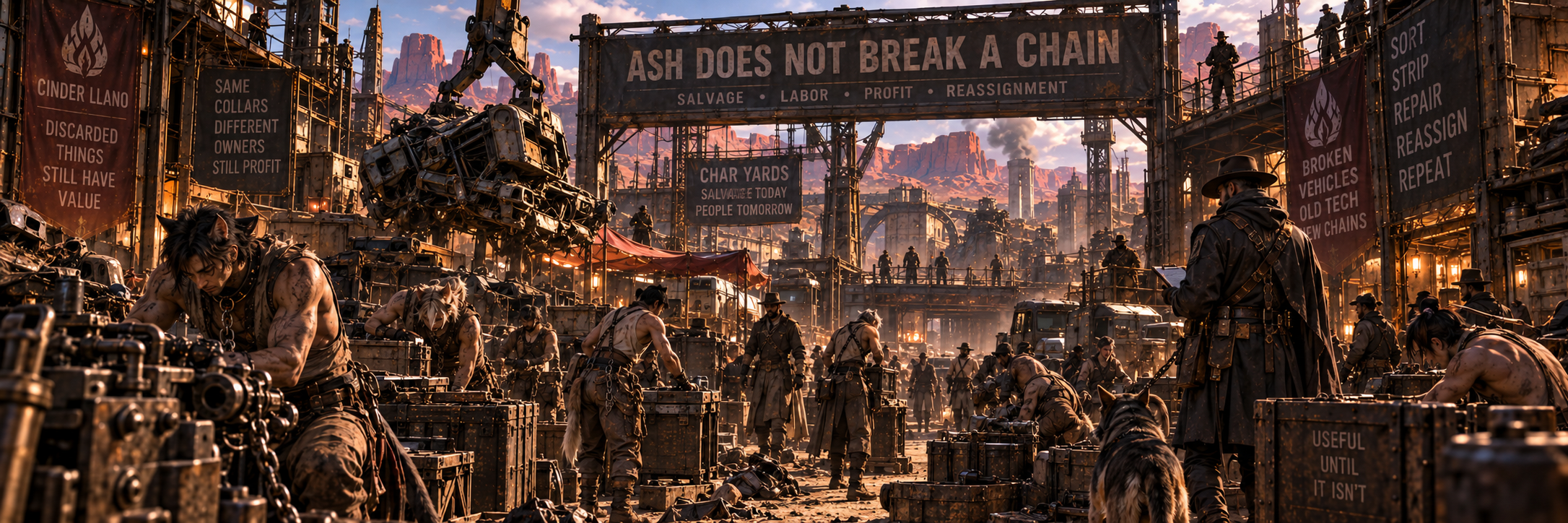
Ash Does Not Break a Chain

Cinder's economy consumes broken things. Demi-humans are folded into the same logic. Human owners assign them to salvage yards, repair bays, road labor, market work, tracking, guard duty and whatever dangerous task can be justified as efficient use.

A burned record may make ownership harder to prove. The physical chain remains much easier to understand.

Labor Assignment

Used Until Nothing Useful Remains

Salvage Sorting

Metal, electronics, vehicle parts and damaged equipment separated for resale or repair.

Vehicle Stripping

Heavy labor dismantling convoy wreckage and old corporate vehicles.

Repair Assistance

Tool handling, lifting, parts hauling and support inside mechanical yards.

Greenhouse Labor

Old Vale structures repurposed for food, storage, medicine or off-book work.

Tracking

Scent-capable demi-humans used in bounty work and retrieval.

Guarding

Armed labor performed under restraint and human command.

Market Work

Carrying, service, cleaning and freight movement through Burnline and Char Yards.

Road Labor

Convoy loading, repairs, barrier work and infrastructure maintenance.

Identity Erasure

Burning the Record Does Not Free the Body

Destroying ownership history can save someone who already escaped. Destroying it while they remain captive can simply make resale easier.

Old NameDestroyed
Previous ClaimUnknown
Transfer HistoryIncomplete
New ClaimFiled
Physical StatusStill Chained

Erasure can be liberation, camouflage or another kind of theft. The difference is who controls what comes afterward.

Ordinary Cinder Llano life among burned buildings, markets, food counters and chained demi-human workers
Daily Life

People Still Have to Live in the Ash

Cinder Llano still has breakfast counters, schools, repair stalls, laundry, neighborhood kitchens, market errands and families arguing over whose turn it is to fetch water.

The town's ugliness becomes more believable because people do not spend every hour committing a conspiracy. Some are fixing generators. Some are doing homework. Some are buying soup. Some are pretending they did not notice what passed through Railbone last night.

Daily Rhythm

The Day Starts With What Still Works

06:00

Wind and road conditions checked before salvage crews move.

07:30

Char Yards open and repair crews begin stripping yesterday's wrecks.

09:00

Ashcourt offices begin hearing claims, debts and disputes.

11:00

Burnline Road reaches peak convoy and market traffic.

14:00

Heat slows exposed work and pushes people into shade, shops and old greenhouse structures.

17:30

Blackgrass kitchens and markets fill as crews return.

20:00

Railbone becomes much busier than official traffic reports suggest.

23:00

Someone burns something they will insist was only trash.

Community Services

Normal Things in an Abnormal Town

Food HallsCheap meals, communal tables and half the town's usable gossip.
SchoolArithmetic, reading, road safety, storm survival and learning which adults should not be trusted.
LaundryClothes still need washing even when somebody has hidden route messages in the seams.
RepairsVehicles, pumps, generators, comms and scanners all survive through constant patchwork.
WaterCollected, rationed, hauled and discussed far more often than outsiders expect.
MarketsFood, tools, clothing, salvage, medicine and whatever is currently legal enough to display.
MedicineOrdinary care and dangerous off-book treatment often share walls.
Storm ShelterThe great equalizer until somebody recognizes somebody else inside.
Cinder Llano evening salvage district with repair shops, market stalls, old infrastructure and roadside businesses
Places · Salvage · Daily Life

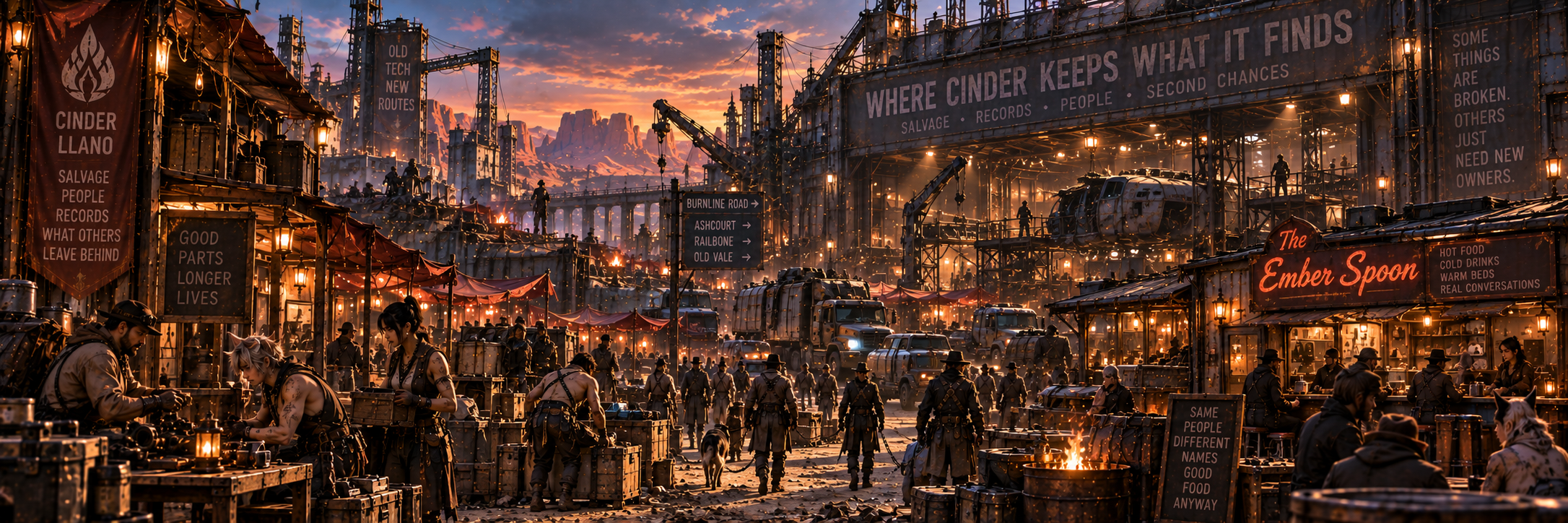
Where Cinder Keeps What It Finds

Cinder's important places rarely begin with prestigious architecture. They begin with whatever still has walls, power, a roof or equipment somebody can repurpose.

A greenhouse becomes a clinic. A rail platform becomes a handoff. A machine depot becomes a market. A burn pit becomes a ritual. Nothing here stays only what it was built to be.

Important Places

Places That Should Have Been Abandoned

Ashcourt · Claims

Ashcourt Claim Hall

Ownership disputes, salvage claims, debt contracts, bounty challenges and identity corrections.

Ashcourt · Law

Cinder Sheriff Annex

A fortified law office with more guns than staff and authority that changes depending on outside pressure.

Old Vale Campus · Data

Old Vale Data Silos

Rumored storage for stolen Purity Grid records, conservatory transfers and erased ancestry files.

Char Yards · Salvage

Char Yard Cathedral

A massive machine depot filled with dismantled vehicles, scanner parts, restraint hardware and old corporate technology.

Old Vale Campus · Ruins

Glassroot Greenhouses

Cracked vertical farms with sections still sealed, powered or useful during storms.

Railbone · Transit

Railbone Platform 8

A dead platform used for handoffs when roads become too visible.

Eastern Road · Passage

Cinder Tollhouse

Controls which papers, cargo and vehicles leave town toward eastern routes.

Saint Cinder · Ritual

Record Pyre

Public burn pit used for symbolic debt clearing, imposed-name destruction and evidence disposal.

Daily Life Places

Places People Go Without a Conspiracy

Blackgrass · Food Hall

Blackgrass Kitchen

A communal food hall serving neighborhood families, workers and travelers. Ash Mother influence exists, but most meals are genuinely just meals.

Blackgrass · School

Ash-Sick School

A messy local school where children learn ordinary subjects beside road safety, storm survival and practical caution.

Old Vale Edge · Clinic

Burnt Orchard Clinic

Road injuries, restraint wounds, hidden hybrid problems and normal community medicine under one patched greenhouse roof.

Convoy District · Repair

Thornless Yard

A functioning repair yard for convoy trucks, plates, parts and occasionally questions best left off the invoice.

Blackgrass · Lodging

Red Thread Boarding House

Cheap rooms and an ever-changing reputation for sanctuary, surveillance or both.

Burnline Road · Closed Motel

False Dawn Motel

Officially closed after sanctuary scandals. Still illuminated at night for reasons nobody claims responsibility for.

Saint Cinder · Neighborhood

Saint Cinder Quarter

Shrines, food counters, public kitchens, traveler shelters and the closest thing Cinder has to a neighborhood commons.

Char Yards · Market

Char Yards

Thousands of people shop, barter, repair equipment and work here every week. Not every transaction is criminal. Just enough of them.

Cinder Llano underground sanctuary route moving through Railbone and abandoned Old Vale infrastructure
Underground · Sanctuary · Erasure

Sanctuary Passes Through Wearing Ash

Cinder Llano is not a sanctuary town, but sanctuary moves through it constantly. Railbone tunnels, Blackgrass kitchens, abandoned greenhouses, clinic rooms, freight spaces and old service corridors can all become temporary routes when the road is watched.

The network survives because nobody assumes today's safe place will still be safe tomorrow.

Underground Networks

The People Who Erase the Trail

Red ThreadMoves fugitives and rewrites route knowledge when safe passages fail.Compromised
Ash MothersHide children, injured fugitives and exposed hybrids through kitchens, homes and shelters.Quiet
Spoiled GardenCorrupts Brazorian records, ancestry files and biological certainty.Hunted
Jacklight CrewsTarget bounty relays, scanners and surveillance infrastructure.Reckless
Thornwyck ContactsSeek testimony and move sanctuary-bound survivors through eastern routes.Watched
Veyrhalden RunnersPurchase passage through Tollhouse routes toward Blackfen-linked networks.Costly
Brazorian DefectorsBring medical knowledge, stolen files and very complicated consciences.Useful
Evidence Decision

Some Fires Are for Warmth

Cinder's underground understands that destroying evidence is not automatically liberation. The same file can endanger a fugitive, prove a trafficking route, expose a foreign government or identify somebody's missing family.

Burn
Hide
Alter
Sell
Preserve

The hardest question in Cinder Llano is rarely whether a record can disappear. It is who survives if it does.

Old Red Road convoy crossing Mesquite red-rock country with chained demi-human captives and ordinary freight traffic
Old Red Road · Overview

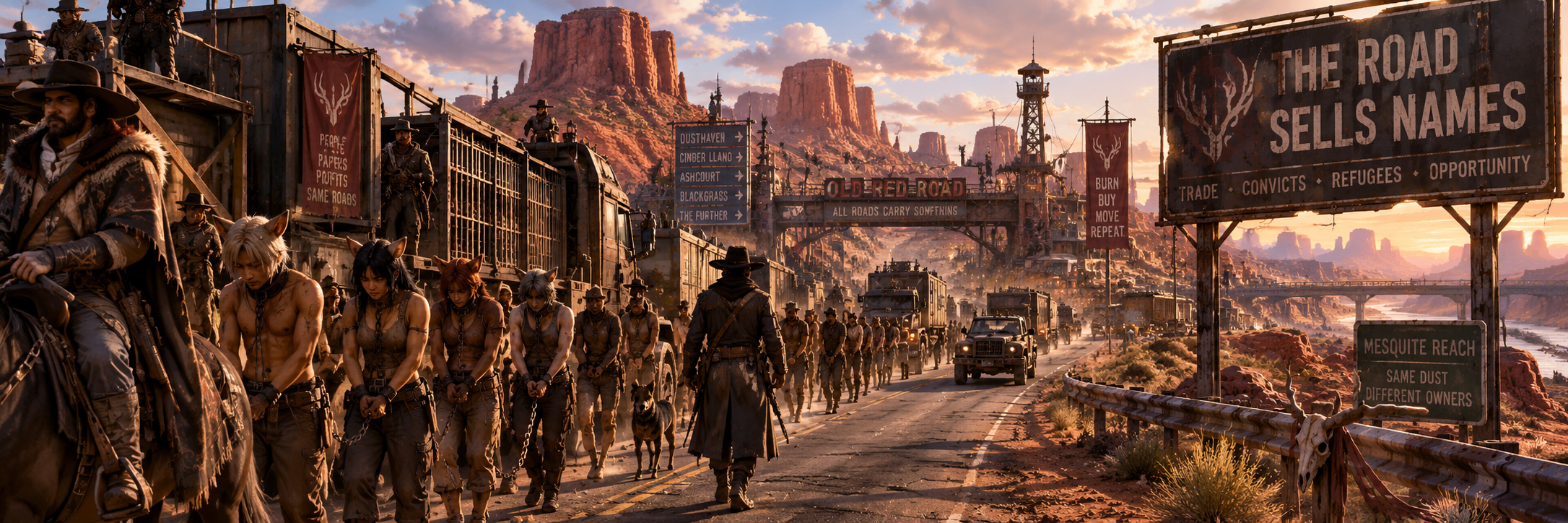
The Road Sells Names

The Old Red Road is the spine of Mesquite Reach and one of Vistall's most infamous movement corridors. Trade, bounty work, slavery, smuggling, sanctuary, migration and ordinary family travel all use the same asphalt.

The road connects the human-controlled west to Dusthaven, Cinder Llano, the Llano Ashlands and routes leading toward Thornwyck and Veyrhalden. Everybody needs it. That makes ownership of passage nearly as valuable as ownership of land.

The Old Red Road does not ask why someone is moving. It only notices whether somebody paid to stop them.

Road Manifest

Everybody Uses It

Trade

Food, fuel, medicine, machinery, water, household goods and everything remote settlements cannot produce themselves.

Convoys

Freight companies, private haulers and armed road crews moving cargo between unstable jurisdictions.

Bounties

Recovery teams hunting escaped demi-humans, debt runners and targets claimed by outside governments.

Trafficking

Enslaved demi-humans transferred between owners, markets, road crews and foreign interests.

Sanctuary

Red Thread, Ash Mother, Thornwyck and Veyrhalden networks exploiting the same movement infrastructure.

Smuggling

Forged papers, people, weapons, medicine, data and cargo somebody does not want inspected.

Migration

Families, workers, drifters and entire settlements following work, water or safer ground.

Memory

Shrines, survivor names and roadside places that remember who did not finish the journey.

Route Status

Movement Is the Only Promise

Open
Controlled
Disputed
Compromised
Dark

A stretch can move between all five conditions before the next convoy catches up to the warning.

The Old Red Road does not promise where someone will arrive. It only promises that staying still has a price too.

Old Red Road passing through toll gates, convoy stops, canyon stretches and changing local authorities
Road Stretches

Every Mile Has a Different Owner

The Old Red Road behaves less like one highway than a chain of temporary jurisdictions. Road Barons, sheriffs, gangs, bounty interests and convoy companies control separate stretches, and their rules rarely agree for long.

Travelers learn the road through names rather than numbers. Collar Mile. Mercy Bend. False Dawn. The Teeth. Every name carries a warning somebody survived long enough to repeat.

Road Stretch Directory

Where the Road Gets Loud

Collar Mile

Auction barns, holding compounds, bounty offices and salvage businesses make this one of the road's most openly predatory commercial stretches.

Mercy Bend

Fortified diners, hidden rooms and old Red Thread rumors. People have been saved here. People have also been sold here.

Chainwater Spur

Water depots, convoy yards and southern freight routes. The recent disappearance of a major convoy made the area everybody's business.

Thirteen Gate Run

A sequence of toll gates whose ownership, legitimacy and actual number change depending on who traveled last.

Road Stretch Directory

Where the Road Gets Quiet

False Dawn Flats

Glowing signs promise fuel, medicine, shelter and rescue. Some are legitimate. Some were legitimate last week.

The Teeth Stretch

A canyon route of blind corners, ruined checkpoints, broken towers and excellent ambush positions.

Widow Signal

An unreliable holo-warning network used by officials, hackers, bounty crews and resistance contacts.

Ashchild Crossing

A survivor memorial near the Crown-side approaches marked with water caps, red thread and fragments of old restraints.

Old Red Road checkpoint where human authorities inspect claims beside chained demi-human captives
Road Law

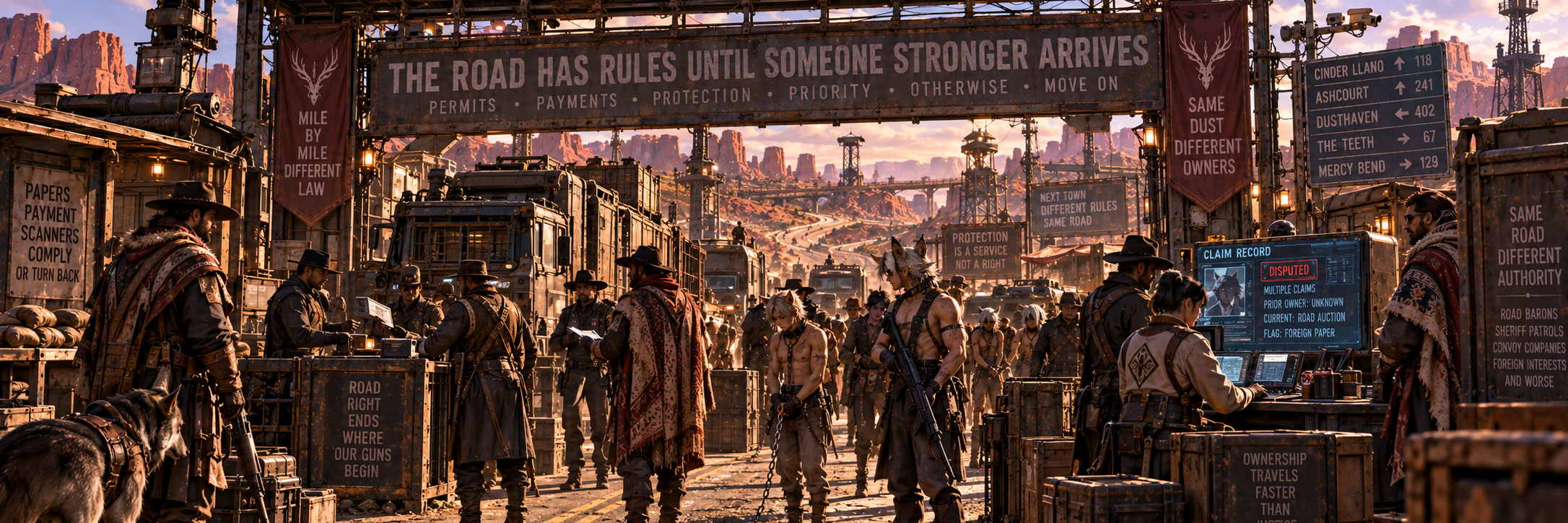
The Road Has Rules Until Someone Stronger Arrives

Road law is practical, local and heavily dependent on enforcement. Paid protection may be recognized at one checkpoint and ignored at the next. A valid claim may become disputed when another authority has more money or more guns.

The road has procedure. It simply has no guarantee that procedure survives contact with the next jurisdiction.

Traveler's Road Code

What the Road Says Should Happen

Road RightPromisePaid protection should guarantee passage.RealityProtection ends wherever somebody refuses to recognize the payment.
Water DebtPromiseWater given in need creates obligation.RealityMercy can become leverage very quickly.
Guest RightPromiseFood and shelter under a roof protect a traveler until sunrise.RealityFalse sanctuaries advertise the same promise.
Claim PriorityPromiseRecognized paperwork determines custody.RealityThe strongest local authority determines which paperwork matters.
Toll AuthorityPromisePay the toll and continue.RealityThe price may change while the vehicle is still stopped.
Claim Priority

Whose Claim Crosses the Checkpoint?

Owner ClaimRecognized where local authority accepts the ownership record.Recognized
Bounty ClaimOften valid only where the issuing authority paid the appropriate fees.Conditional
Debt ClaimDust Debt may create labor obligation under local law.Local
Foreign PaperSan Aurelan, Pecos or Brazorian documentation may carry weight until challenged.Foreign
Gang ClaimLegally meaningless until the gang controls the checkpoint.Practical
Sanctuary ProtectionOnly as strong as the people willing to enforce it.Disputed

A ruling that saves someone at Mile 42 may mean nothing at Mile 47.

Old Red Road convoy stop with drivers, families, mechanics, diners and chained demi-human workers
Human Road Life

Some People Live Between Mile Markers

For thousands of humans, the Old Red Road is not somewhere they travel. It is where they live. Convoy crews, mechanics, fuel workers, motel families, road merchants and toll clerks build entire lives around traffic that never stays long.

The road produces communities made from repetition. The same diner. The same mechanic. The same fuel clerk. The same stranger every third Tuesday heading east.

Road Occupations

The People Who Keep It Moving

Convoy Drivers

Carry freight across routes where road conditions and local law can change before arrival.

Mechanics

Keep engines, scanners, generators, trailers and patched road technology alive.

Fuel Workers

Control one of the most basic requirements of movement.

Toll Clerks

Sell passage, check permits and occasionally decide which rules apply today.

Road Merchants

Food, medicine, supplies, clothes, maps and everything travelers forgot until they needed it.

Guides

Know storms, back roads, current checkpoint owners and which advertised shortcuts deserve suspicion.

Motel Workers

Provide rooms, showers, laundry, gossip and the unnerving ability to remember faces.

Road Risk Ledger

The People Who Profit When Someone Disappears

Slavers

Transport, sell and reassign demi-human property across overlapping jurisdictions.

Bounty Crews

Recover escaped slaves, debt targets and fugitives for human claimants.

False Guides

Sell routes, sanctuary promises and desperation to whoever pays first.

Road Brokers

Arrange transport, permits, claims and meetings between people who prefer not to meet directly.

Corrupt Toll Operators

Charge for passage, information and occasionally silence.

Informants

Know which traveler is worth more as information than as a customer.

Slave convoy transporting chained demi-humans along the Old Red Road through red sandstone country
Demi-Humans · Transport Slavery

The Chains Travel Too

The Old Red Road is one of Mesquite Reach's main slave-transport corridors. Chained demi-humans are marched, loaded into vehicles, transferred between convoys and moved through the same fuel stations and checkpoints as freight.

An enslaved demi-human may serve as tracker, scout or armed guard during the journey and remain chained themselves. Utility does not change status. Trust does not become freedom.

Transport Assignment

What a Body Becomes on the Road

Cargo Labor

Loading, unloading and moving freight between convoy vehicles and depots.

Tracking

Scent-capable demi-humans used by bounty and recovery crews.

Scouting

Speed, eyesight, heat tolerance and terrain ability converted into road utility.

Guard Duty

Armed security performed while the guard remains physically restrained under human control.

Road Repair

Manual labor maintaining barriers, vehicles and damaged infrastructure.

Domestic Service

Food, cleaning, carrying and camp labor for convoy crews.

Market Transfer

Movement between buyers, auction points and new claims.

Bounty Transport

Captured fugitives moved toward whoever currently holds the recognized recovery claim.

Transfer Route

The Destination Can Change Without Asking

A demi-human may leave one stop assigned to one claimant and arrive somewhere completely different under another.

Origin Claim
›
Road Dispute
›
Transfer
›
New Holder
›
Destination Changed

The road does not need to know somebody's name to deliver their body somewhere else.

Old Red Road diner, motel, fuel station and repair stop at sunset with ordinary travelers and chained demi-human workers
Daily Road Life

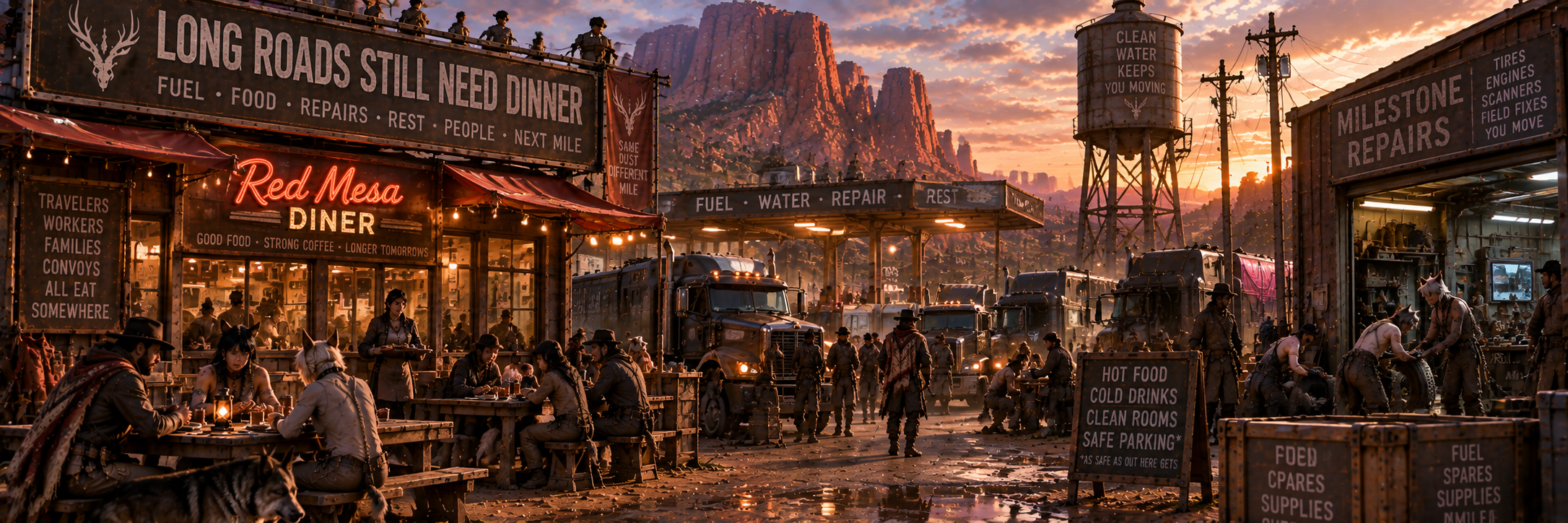
Long Roads Still Need Dinner

The Old Red Road still needs coffee, showers, laundry, motel rooms, fuel, mechanics and somewhere to sit down after ten hours behind a wheel.

Roadside life is built around temporary familiarity. A family eats beside a convoy crew. A mechanic sees the same truck every month. A chained demi-human server learns which travelers tip and which ones look too carefully at the restraints.

Long-Haul Routine

A Day Measured in Distance

05:10

Check road status before yesterday's information becomes dangerous.

06:00

Fuel before the price or road owner changes.

08:30

First tollhouse and first argument over which permit applies.

11:45

Meal stop, coffee and updated road gossip.

14:20

Repair delay somewhere that swears the part will only take twenty minutes.

17:00

Water refill before the next long stretch.

19:30

Find lodging before the next route gets too quiet.

23:10

Decide whether the approaching storm makes travel more dangerous or finally possible.

Road Services

What Every Stop Needs

FuelMovement stops when the tanks do.
WaterThe difference between travel and becoming a roadside memorial.
FoodHot if lucky. Cheap if luckier.
RepairsVehicles, wrist-comms, scanners and generators.
ShowersDust becomes a lifestyle surprisingly quickly.
LaundryConvoy life still produces socks.
MedicineLegal, illegal or simply available.
LodgingA bed, a locked door and ideally only one of those things being suspicious.
Route InformationUsually more valuable than the room.
Storm ShelterBecause sometimes everyone suddenly becomes neighbors.
ChargingWrist-comms, tools and patched vehicle systems.
Scanner ServiceVerification, repair, spoofing or all three.
Competing Old Red Road factions sharing a busy checkpoint and convoy stop
Road Factions

Everyone Wants Something From the Road

The Old Red Road attracts anyone whose power depends on movement. Road Barons want tolls. Convoy companies want predictable passage. Bounty crews want targets. Slavers want markets. Resistance networks want openings.

The road belongs to none of them completely, which is precisely why all of them keep trying.

Road Power

Who Controls Passage

Road BaronsFuel, tolls, depots, water and major convoy permissions.High
Bounty CrewsRecovery contracts, foreign claims and armed pursuit.Mobile
Sheriff PatrolsLocal checkpoints, warrants and whatever authority survives beyond town limits.Local
Convoy CompaniesFreight movement, escort contracts, logistics and route intelligence.Essential
SlaversDemi-human transport, sale and claim movement across jurisdictions.Predatory
Underground Networks

Who Tries to Break the Route

Red ThreadMoves fugitives through changing routes and compromised road systems.Paranoid
Ash MothersOperate through diners, laundries, homes and roadside shelters.Quiet
Jacklight CrewsDestroy bounty boards, trackers, toll systems and surveillance infrastructure.Reckless
Mercy KnivesTarget traffickers, false sanctuaries and bounty crews known for repeated betrayal.Feared
Veyrhalden RunnersMove fugitives toward southeastern routes and eventual Blackfen contacts.Costly
Thornwyck Quiet HandsTry to maintain sanctuary protection through a region where local authority changes constantly.Watched
Old Red Road roadside businesses glowing at blue hour with diner, motel, fuel stop and convoy traffic
Places · Stops · Shelter

Every Light on the Road Means Something

After dark, road lights become their own language. Fuel. Food. Beds. Repairs. Water. Medicine. A checkpoint. A bounty office. A place promising sanctuary that may or may not deserve the word.

Most roadside establishments are ordinary businesses serving ordinary travelers. That normality is exactly what makes the dangerous ones difficult to identify from a distance.

Major Road Places

The Places Every Driver Knows

Dusthaven · Southern Gate

Coyote Gate

Major departure point from Dusthaven toward the Llano Ashlands.

Cinder Llano · Tollhouse

Cinder Tollhouse

Controls which papers, vehicles and stories make it east.

Mercy Bend · Diner

Mercy Bend Diner

Food, information and uneasy neutrality where convoy crews, deputies, bounty hunters and fugitives may share a room.

Chainwater Spur · Depot

Chainwater Depot

Fuel and water control make this one of the road's most important pressure points.

Collar Mile · Market

Collar Mile Auction Barn

Livestock and salvage on paper. Enslaved people laundered through claim and salvage law in practice.

Widow Signal · Holo Tower

Widow Signal Tower

Official warnings, hacked messages, bounty names and missing-person notices flicker across the same damaged system.

Ashchild Crossing · Memorial

Ashchild Shrine

Water caps, red thread, broken tags and old restraint fragments left for people who never finished the road.

Dead Rail · Underpass

Dead Rail Underpass

A handoff point used when visible checkpoints are too dangerous.

Roadside Directory

The Places That Promise Too Much

Motel · Mixed

Quiet Turn Motel

False names, cheap rooms and back exits. Whether those exits help depends on who rented the next room.

Chapel · Unknown

Red Door Chapel

A red-painted entrance that may mean sanctuary, warning, trap or somebody copying an old symbol.

False Dawn · Watched

False Dawn Motel

Closed after multiple false-sanctuary scandals. Still illuminated at night.

Salvage Yard · Mixed

Broken Headlight Yard

Vehicle parts, dead drones and burned convoy equipment with strong Jacklight associations.

Fuel Stop · Moving

No-Name Fuel Stop

A reputation rather than a permanent address. The current location changes faster than the story.

Cinder Route · Quiet

Blackgrass Exit

An unofficial side road toward poorer Cinder districts and hidden contacts.

The Old Red Road has plenty of places to stop. The hard part is knowing what kind of stop someone just made.

The Ashlands Eat the Map
Llano Ashlands // Regional Identity

A COUNTRY INSIDE THE COUNTRY

The Llano Ashlands are the vast red scrubland heart of Mesquite Reach, a place of dry plains, low thorn scrub, old fire scars, abandoned towns, dead rail lines, hidden wells and roads that remain useful long after official maps stop admitting they exist.

The Ashlands are not empty. They are simply difficult to count. Settlements change names, roads change hands, old facilities are stripped and rebuilt, and people disappear into territory too large for any sheriff, road baron or foreign government to truly control.

For authorities, this makes the region a security problem. For bounty crews and traffickers, it makes excellent hunting country. For fugitives, hidden hybrids and the Dust-Free, it offers something rarer: a terrible chance.

Local truth: The Ashlands do not hide people because they are kind. They hide everything.
Red ScrubBroken RoadsDead RailHidden WellsDust-Free Country
Llano Ashlands // Cartographic Failure

WHY MAPS FAIL

The problem is not that nobody mapped the Ashlands. The problem is that the Ashlands refuse to remain the thing that was mapped.

Roads MoveDust buries side roads, convoys carve new ones, old highways reopen, bridges fail and forgotten service routes become important again.
Authority MovesA town can change sheriff, gang protection, road-baron allegiance or local law faster than an outside registry updates its files.
Names MoveRoad names replace legal names. Camps relocate. Settlements adopt new signs. People presumed dead continue living under identities nobody filed.
Storms Edit EverythingDust destroys visibility, covers tracks, kills signals and leaves yesterday's reliable route looking like it was never there.
Official Map Accuracy: Questionable
The Land Changes Before the Signs Do
Llano Ashlands // Major Terrain

THE ASHLAND INTERIOR

01

Red Scrub Plains

Open red earth, thorn scrub, dry grasses and old fire scars. Fast convoy country when the sky is clear. Brutal on foot.

02

Cinder Flats

Old wildfire country littered with buried metal and burned corporate debris. Thermal scans behave strangely here.

03

False Dawn Flats

Broken holo-signs, abandoned fuel stops and shelters with histories of false sanctuary operations.

04

Dead Rail Grid

Half-buried tracks, sealed cargo sites and obsolete systems that sometimes wake during storms.

05

Heat Wells

Old bunkers, buried chambers and shielded basements used to escape heat, storms and thermal detection.

06

Scrub Gullies

Broken ground, sandstone cuts and shallow ravines where hidden camps can disappear from road-level sight.

Llano Ashlands // Informal Corridors

ROUTES THROUGH BROKEN COUNTRY

01
Chainwater SpurA major water and convoy corridor now watched by nearly every faction after a transport vanished during a dust storm.
02
Thornless CutAn eastern sanctuary route associated with Thornwyck contacts. Better for avoiding paperwork than weather.
03
Blackfenward TracksSoutheastern paths feeding toward Veyrhalden-linked smuggling routes and eventual coastal movement.
04
Old Service SpineBuried corporate utility infrastructure connecting sites that no longer officially belong to the same system.
In the Ashlands, a route is useful because somebody knows it. The moment too many people know it, usefulness becomes danger.
The Storm Does Not Choose Sides
Llano Ashlands // Dust Storms

WHEN THE SKY GOES RED

Dust storms rule movement across the Llano Ashlands. A clear road can disappear in minutes. Drone optics become unreliable, holo-signals stutter, portable scanners clog, scent trails break apart and whole convoys are forced into whatever shelter is closest.

Visibility

Headlights shrink to dull amber ghosts. Road edges disappear. Distances become guesses.

Signals

Holo-signs distort, wrist-comms lose clean connection and old towers begin broadcasting garbage.

Tracking

Scent, thermal signatures, aerial surveillance and road cameras all become less dependable.

Shelter

Enemies can end up under the same roof because the weather is temporarily more dangerous than each other.

The storm does not choose sides. People do.
Llano Ashlands // Storm Activity

WHAT MOVES DURING A STORM

FugitivesRoutes too exposed in daylight briefly become possible when drones and distant watchers lose their advantage.
Red ThreadCompromised crossings close while temporary routes activate through kitchens, tunnels, shelters and old infrastructure.
Bounty CrewsSome wait for poor visibility to strike. Others hate storms because a good tracker can lose months of work in twenty minutes.
JacklightsBroken towers, bounty boards, scanners and convoy trackers are easier to hit when emergency systems are already failing.
RecordsManifests change, names disappear, identities burn and one truck can emerge from the storm carrying a completely different story.
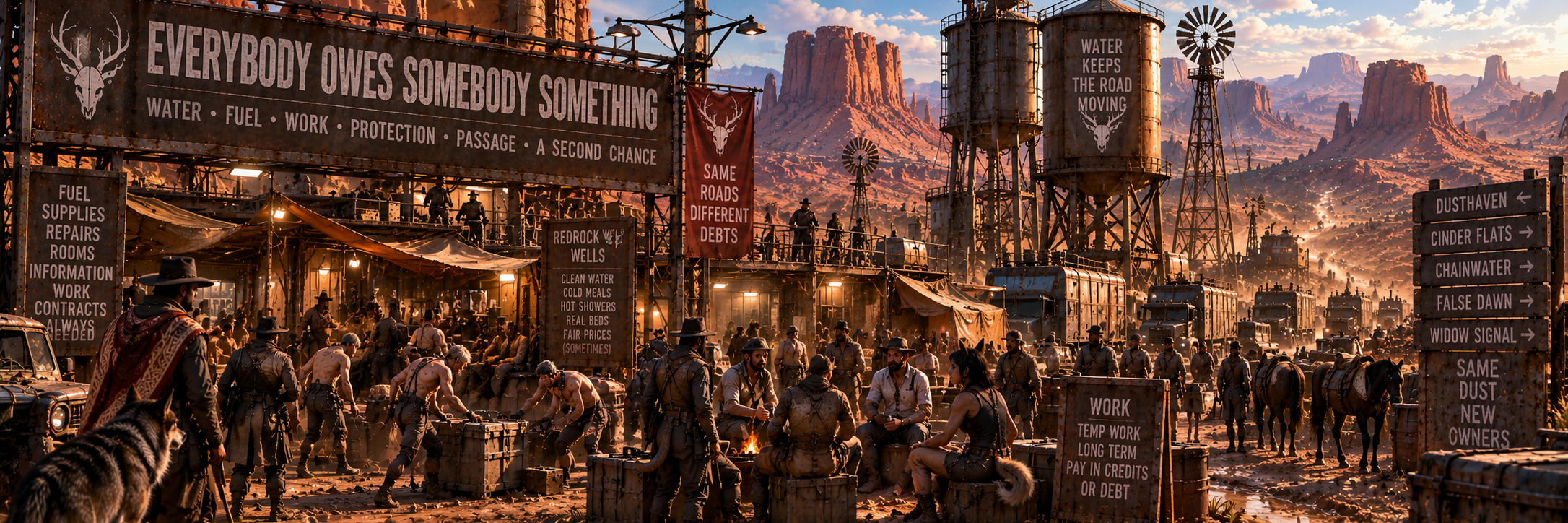
Everybody Owes Somebody Something
Llano Ashlands // Human Life

LIFE BETWEEN CLAIMS

Most Ashland humans are not Road Barons, bounty captains or wealthy ranch heirs. They are mechanics, water-haulers, clinic workers, salvagers, drivers, teachers, farmers, repair crews, cooks and families trying to keep the same roof standing through another season.

Life is shaped by scarcity. Fuel matters. Water matters more. A broken vehicle can become a financial crisis. A storm can erase a week's work. A closed depot can isolate a settlement before anyone in Dusthaven notices.

This creates a culture of practical favors and dangerous obligations. Someone fixes an engine now because someday they may need medicine. Someone shares a well because leaving travelers to die creates enemies. Someone feeds a stranger because Guest Right still matters here.

Survival is social before it is heroic
Llano Ashlands // Debt Economy

WATER, WORK, AND WHAT YOU OWE

Water Debt

Giving water can be mercy, hospitality, investment or leverage. The difference depends entirely on who remembers the favor later.

Road Debt

Fuel, repair, towing, protection and convoy passage can create obligations that survive long after the trip ends.

Medical Debt

A clinic may save a life and then hold the patient through fees, favors, information or forged contracts.

Family Debt

Old ranch and road families often treat inherited favors, grudges and obligations as if they were property.

The dangerous sentence: “You owe me.” In the Reach, it can mean gratitude. It can also mean the beginning of a claim.
Open Land Is Still a Cage
Llano Ashlands // Demi-Human Status

FREE ENOUGH TO RUN

Demi-human status changes from town to town, checkpoint to checkpoint and sometimes from one claimant to the next.

Claim-HeldOwned through recognized papers, debt, ranch tradition, convoy attachment or local authority.
Bounty-FlaggedWanted by an owner, corporation, estate, court, gang or outside government.
Local-ProtectedAllowed to live semi-freely because a town, sheriff, family, gang or militia recognizes them as local.
UnpaperedNo valid record. Dangerous because someone else may try to assign a status first.
Human-PassingHidden ancestry or traits allow ordinary movement until injury, scanning, betrayal or family conflict exposes them.
Dust-FreeOutside active claims and formal tracking. Closest to freedom, and often the least protected if found.
Llano Ashlands // Survival By Species

FOUND IS NOT THE SAME AS SAFE

Coyote LinesOften know forgotten roads and settlements, but Reach folklore also stereotypes them as thieves, guides and liars.
Jackrabbit LinesSpeed helps on broken ground. Open country still leaves runners exposed to vehicles, drones and long-range watchers.
Avian LinesCan spot convoys and storms early, but aerial movement can become dangerously visible against open sky.
Reptilian LinesHeat tolerance can buy distance others cannot survive, while water scarcity remains a problem no species fully escapes.
Human-Passing HybridsCan disappear into settlements for years, provided nobody powerful becomes curious enough to verify what they are.
The Ashlands can hide someone from the Grid. They can also leave them alone with thirst, injury, betrayal and nobody coming.
The People the Grid Lost
Llano Ashlands // Dust-Free

LIVING OUTSIDE THE FILE

Dust-Free is the Reach term for people who have slipped every active claim and built lives beyond ordinary tracking.

Some are escaped demi-humans. Some are human-passing hybrids. Some are outlaw humans, failed smugglers, defectors, former company workers or children born under names no government ever received.

They are not one political movement and they are not automatically resistance fighters. Most are doing something much less glamorous and much harder: keeping themselves alive without becoming legible enough for somebody to own, arrest, recover or reclassify them.

No Clean RegistryFalse NamesHidden WellsModified TechMixed CommunitiesNo Route Safe Twice
Being missing from the Grid is not the same thing as being missing from the world.
Llano Ashlands // Hidden Communities

CAMPS THAT REFUSE TO STAY PUT

Storm Camps

Temporary shelters that exist for hours or days, then disappear before a route becomes predictable.

Hidden Settlements

Some have survived for generations around concealed water, old infrastructure and locally defended routes.

Ghost Town Reclaims

Abandoned settlements quietly repopulated under different names, flags or no official identity at all.

Mobile Communities

Vehicle groups, caravan families and convoy-sized camps that survive by never remaining claimable for long.

Red ThreadShares route warnings without requiring central registration or permanent safehouse records.
Ash MothersMove children, injured fugitives and people too exhausted to survive another road immediately.
Outside AlliesThornwyck contacts, Eirwold scouts and Veyrhalden runners sometimes intersect with Dust-Free territory.
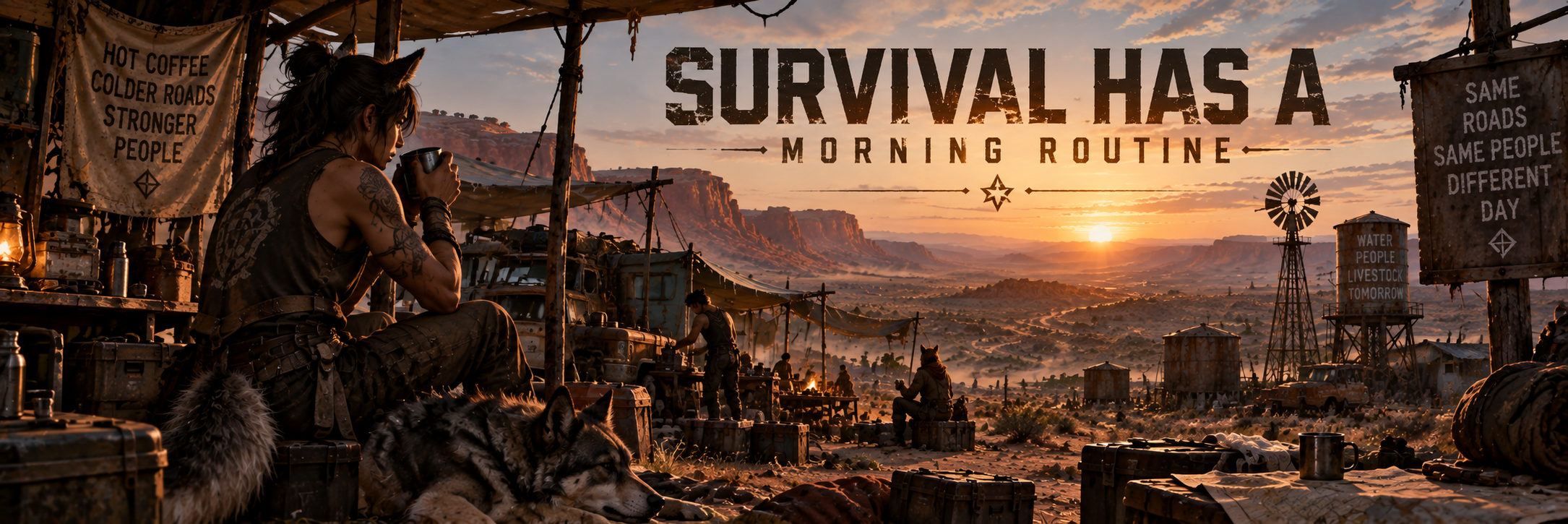
Survival Has a Morning Routine
Llano Ashlands // Ordinary Life

ANOTHER DAY UNDER THE SAME SKY

MorningCheck Water First

Wells, tanks, filters, weather reports, vehicle heat, animal water and road conditions are checked before plans become real.

DayWork Around Heat

Repairs, salvage, teaching, cooking, driving, clinic work, trading and maintenance dominate the hours before the worst heat.

EveningPeople Come Back

Meals stretch longer, engines cool, markets wake up, children play and everybody notices who returned from the road late.

The Ashlands are dangerous, but nobody survives by performing danger every hour of the day. People still complain about coffee, argue over repairs, forget errands, flirt badly, teach children, mend clothes, cook dinner and wonder whether a neighbor is ever returning the borrowed wrench.

The apocalypse is cancelled. It is Tuesday.
Llano Ashlands // Community

HOW PEOPLE MAKE A LIFE HERE

Food

Communal kitchens, preserved staples, road meals, camp grills and whatever can survive heat and transport.

Water

Stored carefully, traded carefully and discussed with the seriousness other places reserve for politics.

Work

Repair, salvage, hauling, clinic work, trade, driving, teaching, farming and keeping old systems alive one patch at a time.

Children

Learn weather, road signs, scanner lies, water discipline and which adults can be trusted before anyone wishes they had to.

Affection

Usually practical. Someone saves a seat, fills a tank, fixes a fan, watches a child or stays awake until headlights return.

Entertainment

Music, cards, shared meals, patched holo-shows, local gossip and anything that makes one night feel less borrowed.

The Reach is unstable. People are not temporary just because the law treats them that way.
Every Well Has a Story
Llano Ashlands // Known Places

PLACES THE OFFICIAL MAP FORGOT

No-Name WellsHidden water sources controlled by Dust-Free camps, ranch families, Red Thread contacts or nobody anyone can prove.
Dead Mile MotelA collapsed roadside shelter that changes occupants, loyalties and safety status constantly.
Red Thorn CampA rumored Dust-Free settlement among scrub gullies and old service tunnels. It may be peaceful, armed and mobile.
Broken Spur YardA dead rail yard full of rusted cars, failed locks, cracked scanners and maintenance passages.
Mercy Knives CairnA stone marker associated with the judgment of false sanctuary operators. Somebody keeps replacing its red cloth.
Old Service SpineA buried corporate utility corridor connecting abandoned sites beneath the scrubland.
Widow Signal Tower 9A hacked emergency tower flickering between warnings, missing-person faces, sanctuary codes and corrupted government messages.
Ashchild CrossingA ruined convoy stop and survivor memorial where water caps, tags, coins, feathers and red thread accumulate.
Llano Ashlands // Ash Baptism Hollow

WHERE THE OLD FILE ENDS

Ash Baptism Hollow is one of the Ashlands' quiet identity sites, used by Dust-Free communities and people leaving dangerous records behind.

Those casting off imposed names, ownership papers, false identities or records that could lead hunters to them may mark the transition with ash and water. It is not a government ceremony, formal religion or universal Dust-Free tradition. It is simply one way people draw a line between the file that hunted them and the life that came after it.

Some burn papers. Some destroy tags. Some bury names. Some keep every scrap as evidence and change nothing except what they answer to.

The Record

Ownership papers, bounty names, registry codes, false custody identities and histories written by someone else.

The Ash

What can be burned, broken or reduced until the old claim no longer has a clean object to point toward.

The Water

Not forgiveness. Not purity. Continuation. Enough to wash dust from the hands and keep moving.

The Name After

Chosen, reclaimed, borrowed, temporary or still undecided. The important part is who gets to choose it.

The old file can end without the person ending with it.
Llano Ashlands // Mesquite Reach // 2097 A.E.
Mesquite Reach // Current Era // 2097 A.E.
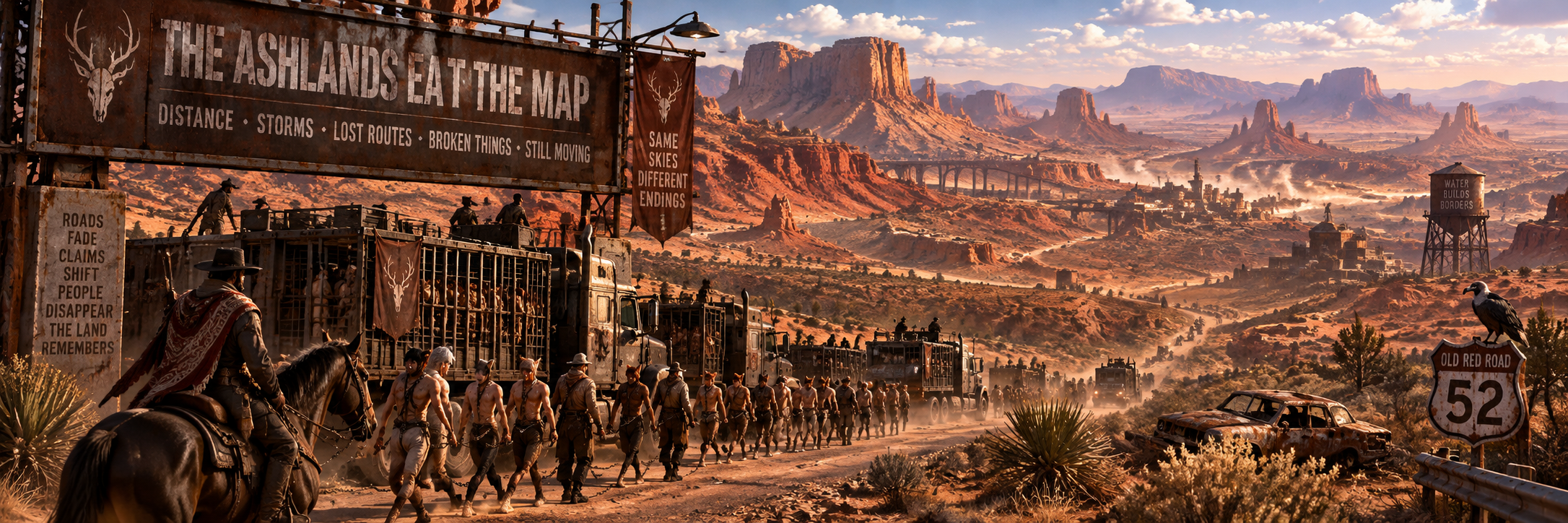
THE REACH IS VOLATILE EVEN BY ITS OWN STANDARDS

Mesquite Reach has never depended on stability. It depends on movement, negotiation, local power and enough functioning road to keep everyone fed.
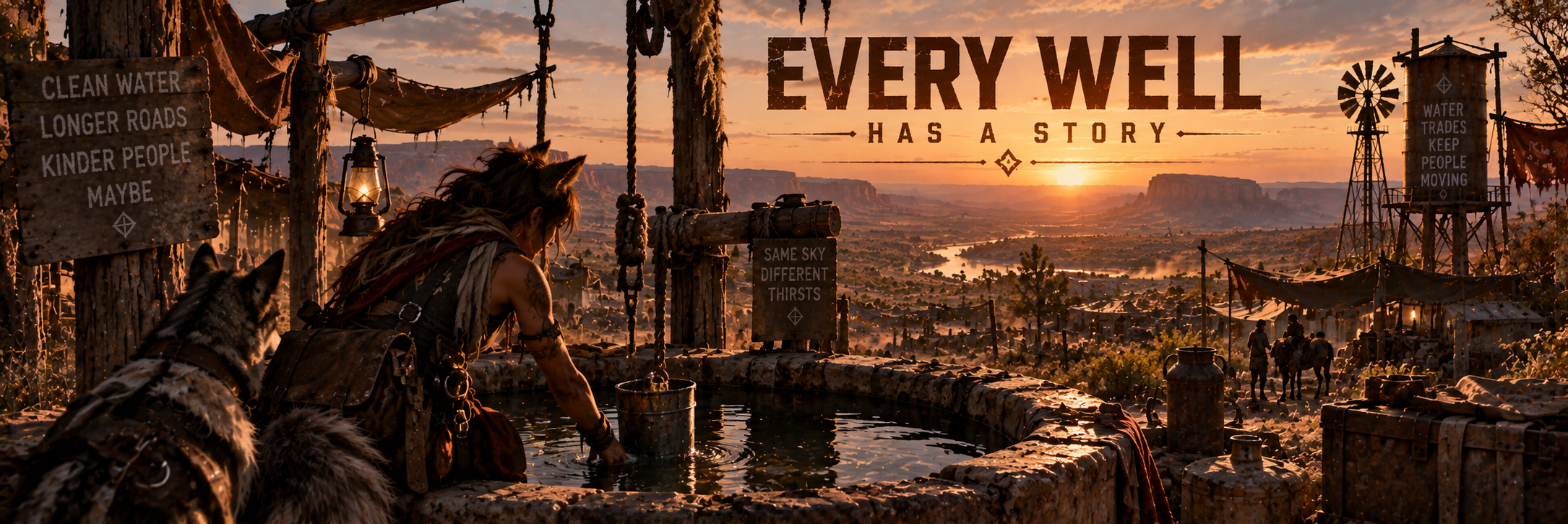
That balance is beginning to fail.

False sanctuary houses have been exposed along the Old Red Road. A major convoy disappeared near Chainwater Spur during a dust storm. Foreign recovery teams are pushing farther into Reach territory while smugglers, sanctuary operatives, bounty crews and local militias compete over the same routes.

None of these events alone would frighten Mesquite Reach.

The problem is that they are happening at the same time.

Official position: Order will be restored.
Local response: Nobody believes that. Not even the government.
Current Era // Road Pressure

THE OLD RED ROAD IS LOSING ITS RULES

The most dangerous road in Vistall has always been unstable. Now the instability feels deliberate.

False SanctuarySeveral houses using trusted rescue language and symbols have been exposed as traps, damaging confidence in routes that already depended on fragile trust.
Compromised RoutesThe Red Thread is warning that multiple safe corridors can no longer be trusted. Its oldest rule matters more than ever: no route is safe twice.
Bounty BoardsNames are disappearing from public bounty systems across multiple towns, sometimes replaced by missing-person notices before authorities restore the boards.
ChainwaterA major convoy vanished during a dust storm near Chainwater Spur. No clean wreckage, bodies or reliable manifest have resolved what happened.
Three Dark TownsThree settlements lost their bounty boards and went dark on the same night. Coordination is now harder to dismiss as coincidence.
Current Era // Foreign Pressure

EVERY OUTSIDE POWER HAS ITS HAND IN THE DUST

San Aurelo

Demanding stronger cooperation after elite household demi-humans escaped and disappeared into Reach routes.

The Pecos Crown

Sending armed recovery teams deeper into Mesquite territory, testing how much local authority will tolerate before pushing back.

Brazoria Vale

Searching for stolen Purity Grid records believed to have moved through Cinder Llano and surrounding Ashland networks.

Thornwyck

Increasing sanctuary activity along eastern routes while exposed safehouses force rerouting through less dependable territory.

Veyrhalden

Smugglers and Blackfen-linked runners are purchasing influence in southern road towns and expanding access toward coastal routes.

Road Barons

Threatening to restrict fuel access unless bounty laws are strengthened, turning infrastructure into political pressure.

Mesquite Reach resents foreign control. That has never stopped foreign money from buying local hands.
Current Era // Emerging Pattern

SOMEBODY IS CONNECTING THE ANGER

The Reach has always contained resistance. What worries its ruling powers is not resistance itself. It is overlap.

Jacklight Crews are wiping bounty systems. Mercy Knives are targeting repeat traffickers and false sanctuary operators. Red Thread routes are shifting faster. Dust-Free settlements are spreading. Survivors from San Aurelo, Brazoria Vale and the Pecos Crown are beginning to encounter one another in the same corridors.

Rumors of a mythic-blood fugitive traveling through the Ashlands under a false road name are adding even more pressure. Every major outside power has reason to search. Every sanctuary faction has reason to hide them. Every trafficker has reason to sell the rumor whether it is true or not.

Mesquite Reach has always survived because its anger was fragmented.

Now people are starting to wonder what happens if it stops being fragmented.

Dusthaven has always lived with violence. What scares people now is coordination.
Current Status // Unstable // No unified authority confirmed